I was asked repeatedly throughout this year’s Bitcoin 2024 conference what my highlight of the moment was — what the signal was amongst the noise. As I returned from Nashville, it occurred to me that, each time, I could never answer the question satisfyingly.
In part, because I simply couldn’t keep up. The activity around the news desk and my support for those running the show left me with little time to focus on anything else. I can’t say I regret it. Anyone who gravitated around our livestream studio space during the week can attest to the energy surrounding it. The Bitcoin Magazine news desk was the veritable heartbeat of the conference.
Now that I’ve had time to collect my thoughts, I can confidently say what stood out most from the conference was the understated presence of the Lightning Network. In different times this would have been a concern but this felt different. It struck me that Lightning has not only arrived but has matured beyond what any other scaling layer can realistically claim.
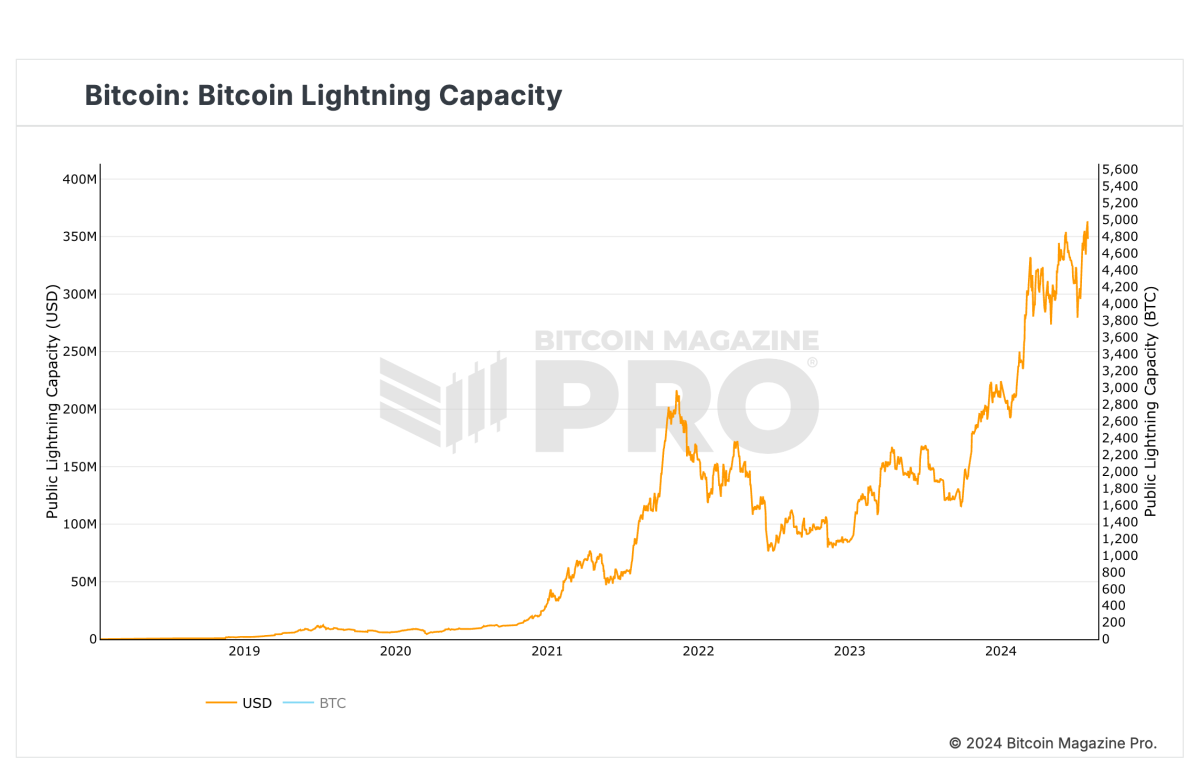
Largely unnoticed, the payment protocol has quietly inserted itself into every piece of major Bitcoin infrastructure. Most of the world's leading exchanges now support it, with some running the largest nodes on the network. The dollar-denominated capacity of the network is at an all-time high, and every operator I spoke with this week confirmed its rapidly improving reliability.
Though it might have looked to the casual conference goer that Lightning had taken a back seat to other popular up-and-coming protocols, it was clear during the conference how vastly ahead it is from the rest of the field. While I was fortunate to meet many talented individuals working on this new generation of Bitcoin technical design, I left the event with more questions about their progress than when I arrived. Lightning, on the other hand, answered many concerns about its status and the road ahead.
Sights on settlements
A recurring narrative during the event was the protocol’s promises as a settlement network. Initially promoted as a retail payment solution, Lightning’s latest and biggest headways might be among businesses and institutions looking to satisfy liquidity needs. The vision, popularized notably by Jack Mallers at Strike, feels more concrete than ever, with infrastructure company Lightspark now at the forefront of these accomplishments. Last Thursday, on the Nakamoto stage, Lightspark’s co-founder Christian Catalini argued for Lightning’s favorable position as a bridge between companies and various financial institutions:
If you think about the challenge of moving value not just between a few countries but two hundred or more countries, every day, 24/7, with deep liquidity. There is only one asset, and that asset is bitcoin. It has regulatory clarity, it has on and off-ramps in pretty much every country around the globe. Now we can connect it all in an open way.
Lightspark’s recent announcement of its partnership with Latin America’s banking giant Nubank clearly outlines the potential for existing firms to modernize their infrastructure using the Lightning network.
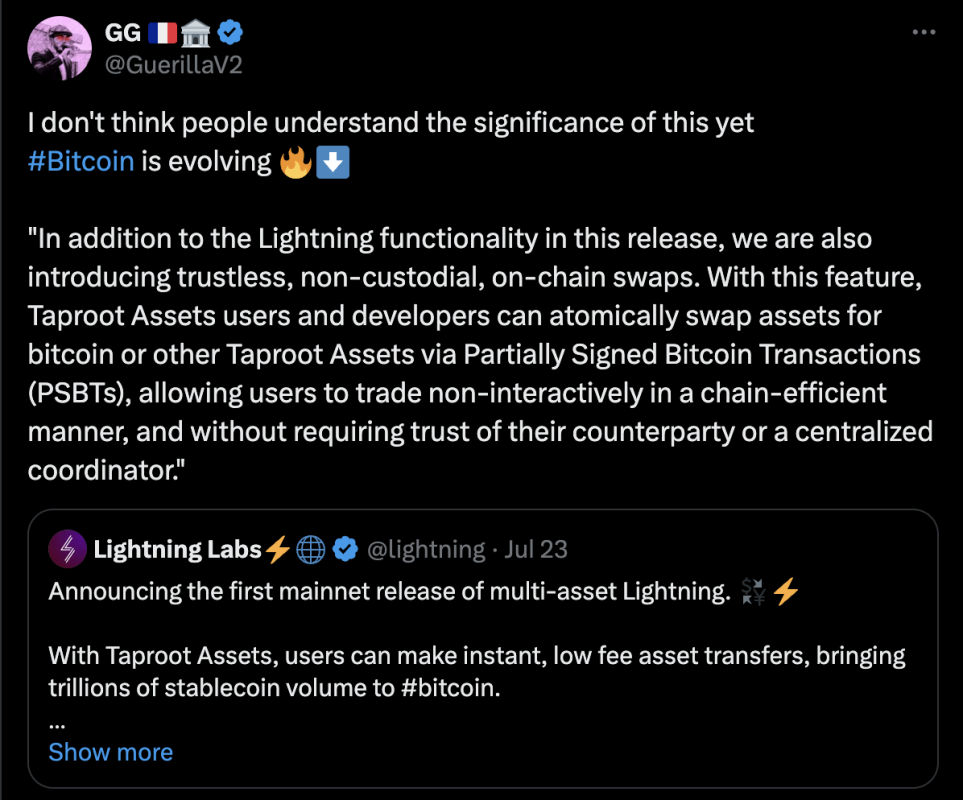
Further strengthening the case of Lightning as a rail to connect the global economy, last week's release of Lightning Labs’ Taproot Asset protocol introduces yet another opportunity for the scaling layer to establish itself as the dominant value transfer protocol on the internet. Before Lightning can come for VISA, it might have to start by displacing SWIFT.
Improving payments
On the payment front, the talk of the town in Nashville was the improvement in user experience brought about by the arrival of features like BOLT12.
Years in the making, the payment protocol offers an intuitive way for users to receive Lightning payments without relying on unreliable, expiring, invoices. It also paves a promising path toward improving users’ ability to receive payments offline, a major pain point of current implementations.
BOLT12 achieves this through static, reusable, offers that do not compromise receiver privacy. Combined with other innovations like DNS payment instructions, it is now possible to create human-readable Bitcoin addresses (ex: alex@twelve.cash) that support different payment formats. Imagine using a single identifier to receive on-chain and Lightning payments regardless of your preferred standards. Twelve.cash, a standout project from this year’s conference hackathon, did a remarkable job highlighting the versatility of this technology, implementing “a simple way to share your bitcoin payment info with the world.”
Other forms of human-readable addresses have existed for some time using the LNURL format but the hope is for users to converge to more mature solutions. Long-time Lightning infrastructure provider Amboss also announced during the event a new Lightning wallet supporting a novel, multi-asset, payment system they’ve called “MIBAN”.
Fragmentation between standards and compatibility issues is anticipated in open and permissionless financial systems. Lightning is further than any alternative in terms of optimizing around these interoperability challenges to ensure seamless payment experiences.
BOLT12 is currently supported by leading wallets like Phoenix and ZEUS, and could land on the Strike app soon.
Following Bitcoin Park’s Lightning Summit around the same time last year, I remember feeling pretty disillusioned about the prospects of consumer Lightning apps. What a difference a year makes. While a fully non-custodial experience might always command a premium, new optimizations, and different security models are emerging that can meet retail users where they are.
Infrastructure at scale
This progress, at every level, would not be possible without the momentous efforts that have gone into infrastructure work over the last couple of years.
Lightspark, which supports Lightning integration for other industry giants like Coinbase and Bitso, is powered by Spiral’s Lightning Development Kit (LDK). Recently announced Alby Hub is also the first production wallet deployed using the LDK node library.
Keep in mind LDK has been in the works for almost four years now. Good things take time. Many people I spoke to during the conference expect the scope and quality of projects to be deployed using this toolkit to significantly accelerate.
Another signal of the evolving Lightning infrastructure came from the release during the week of Breez LDK’s new Liquid integration. This is a trend that is picking up pace and has been pioneered by Boltz’s swapping services. Used in wallet applications like Aqua, Liquid empowers developers to use the sidechain network’s cheap fees to settle transactions in and out of Lightning into L-BTC. While this involves custody tradeoffs, proponents argue it remains a superior option to fully custodial Lightning wallets.
Also in topic during the conference was the progress made at the Lightning Service Provider (LSP) specification level. As a result, the quality of service providers on the network has significantly increased. LSPs are used to provide infrastructure support and liquidity provision to companies wanting to connect to the Lightning Network.
Zeus’s founder Evan Kaloudis shared his company’s effort in this direction:
Since the legal uncertainty in the space arose following the arrest of the Samourai Wallet developers, we've doubled down and now have two different services that provide users with connectivity to the Lightning Network. We've also massively expanded the Olympus LSP userbase; we now are not only powering the ZEUS wallet, but we've now got integrations in a total of four different wallets, including a role as the default LSP in Mutiny Wallet.
Security is another area of the protocol seeing impressive growth. Spiral grantee Sean Gillian’s work on Validating Lightning Signer (VLS) will play a significant role in scaling this technology to power users. Allowing operators to leverage secure enclaves to protect hot signing keys and set spending policies will be required to onboard the next wave of institutional players.
In a panel I hosted Saturday afternoon on Lightning for Institutions, one of the protocol’s creators Tadge Dryja expressed strong interest in the development of more secure key management processes.
We’ve worked out how you can implement multi-signature support for Lightning nodes. We have done the math, we know it works. Now we have to work with everyone to get there.
It would not be an infrastructure section without mentioning the massive innovation around the Nostr protocol and its implications for Lightning. One of my favorite Pitchday projects at the conference was Flash, a new payment gateway platform that leverages Nostr for seamless integration of Lightning into any internet services or products. The consequences of using the Nostr messaging protocol as a bridge between Bitcoin applications are not yet fully appreciated. The Flash team has an incredible vision for it. Shoutout also to Justin from Shocknet who I met and is exploring many interesting ways to scale the Lightning protocol using Nostr's magic sauce.
1.Donald J. Trump and the point of no return. 3 words, “Strategic Bitcoin Stockpile”. It was theorized by many Bitcoiners for years, some would even say dreamed of, and it happened just last week. Fair to say that Bitcoin has indeed crossed some sort of Rubicon on Saturday, a point of no return where everything can suddenly accelerate. The culprit? - goes by the name of game theory. Nations around the world, from this day forward, have to take this idea of a Bitcoin reserve seriously or face the consequences of being left behind. If enacted, the US will own around 1% of the total bitcoin supply.
From the perspective of other countries, this strategy would be tough to replicate as the US basically got this bitcoin for free (through what could most likely be considered illegal and immoral means). Competing nations would be faced with the daunting/impossible task of accumulating hundreds of thousands of bitcoins without paying a huge premium for it. This is where Bitcoin mining becomes a matter of national security. On the back of that announcement from Trump, Michael Saylor also laid out a framework for nation-state adoption of bitcoin as a treasury asset (How to do it sensibly and why it makes sense) in front of 10+ senators. A good idea whose time has come is unstoppable.
2. Institutions are here. The same game theoretics apply for institutions. If nation-states are accumulating Bitcoin, corporations must do the same. Nation-state accumulation basically guarantees price go up over the long term, which means dollar-denominated corporate treasuries will suffer in relative terms. It becomes a bright line denominating winners and losers. Moving part of the treasury into BTC won't even necessarily make you a winner, it'll be the baseline requirement to compete. Anyone who doesn't do it will just be left behind. “It might make sense just to get some in case it catches on"
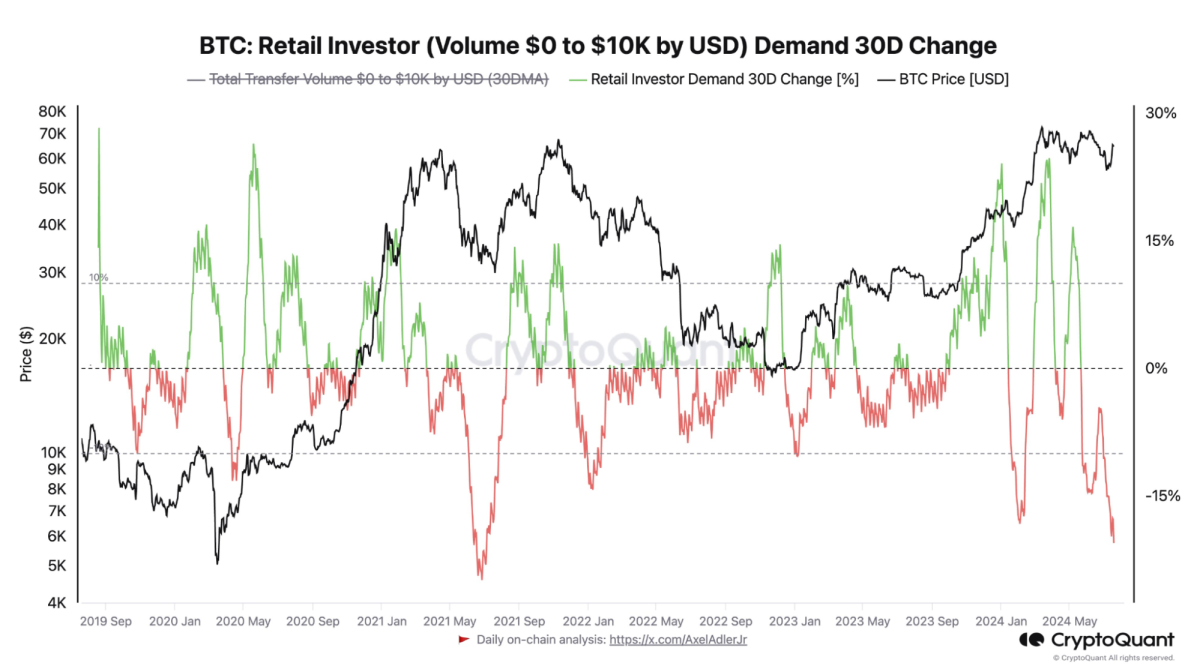
3. Retail is still absent. As the chart below describes, retail flow measured by the 30-day change in total transfer volume for transactions under $10K, is at a 3-year low. Despite BTC being less than 10% away from ATH.
While the conference was an inevitable success in terms of retail participation, it would appear that retail buyers are either exhausted, already all-in or not willing to buy additional BTC at those prices. Another possible explanation for this was the overall feeling throughout the conference of “waiting for the next catalyst”.
UTXO Alpha Day - The first of many for Venture Capitalists
1.We are blessed to support the best people. UTXO Management was hosting its inaugural investor day, UTXO Alpha Day, at the Bitcoin 2024 conference. We assembled hundreds of capital allocators, entrepreneurs, institutional investors, and angels for the event, where we explored yield-bearing assets in Bitcoin, the landscape of new Bitcoin layers, and the emergence of Bitcoin as the ultimate treasury asset. The event was a success and a great reminder that Venture Capital is first and foremost about exceptional individuals all competing to bring new utility to Bitcoin. BTC Startup Lab also hosted an incredible mixer event on Friday where we had the pleasure of meeting many different investors and founders. I left the event with the feeling that Bitcoin founders are a rare breed that must be welcomed by the US with open arms. Their focus is very much on building and gearing up for a Bull market - expect everything to happen all at once when Bitcoin decisively breaks its previous ATH.
One of the main takeaways from the conference was that investor appetite for Yield strategies native to Bitcoin is growing beyond what we initially anticipated. When we talk about idle capital, most people tend to think about the millions of BTC sitting in wallets, however, last week it became clear that the opportunity is equally attractive to crypto investors currently allocated on different blockchains. TVL is mercenary in the current environment and many discussions we’ve had came from investors either looking to switch from Bridged BTC (WBTC for example) on other blockchains to Bitcoin L2’s, or from investors looking for more attractive opportunities than Ethereum or Solana-based coins as the incentive campaigns of bitcoin projects often yield attractive current returns and asymmetric upside.
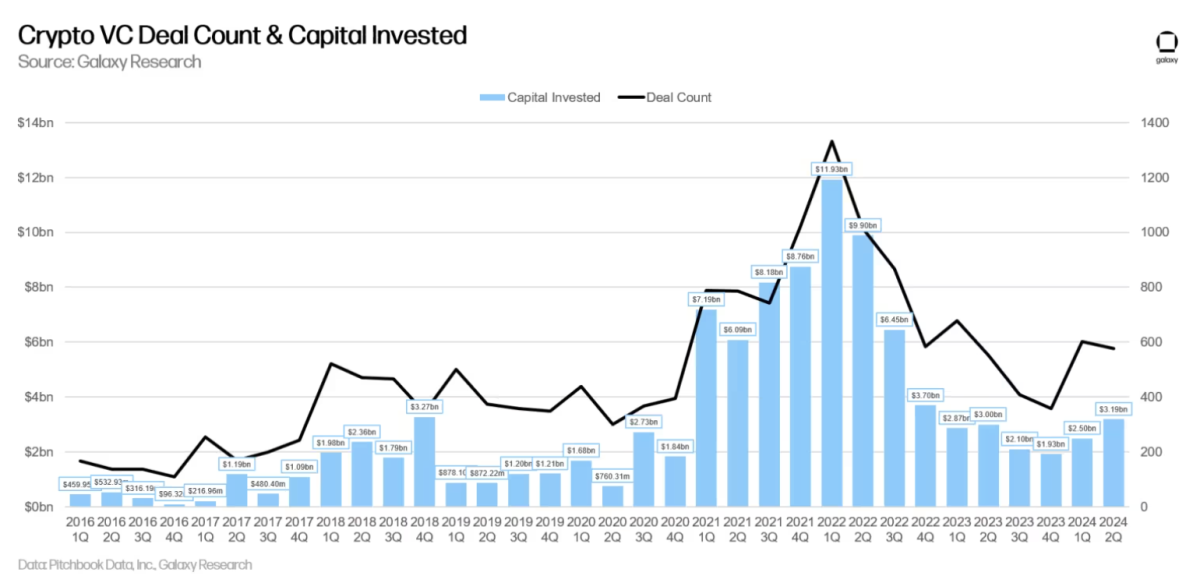
2. Venture Capital knowledge about Bitcoin remains limited. As it was highlighted in the most recent Galaxy report on Blockchain Venture Capital, the appetite for crypto investment has steadily increased YTD but remains nowhere near the top of Q1 2022. From the report: “In Q2 2024, venture capitalists invested $3.194bn (+28% QoQ) into crypto and blockchain-focused companies across 577 deals (-4% QoQ).”
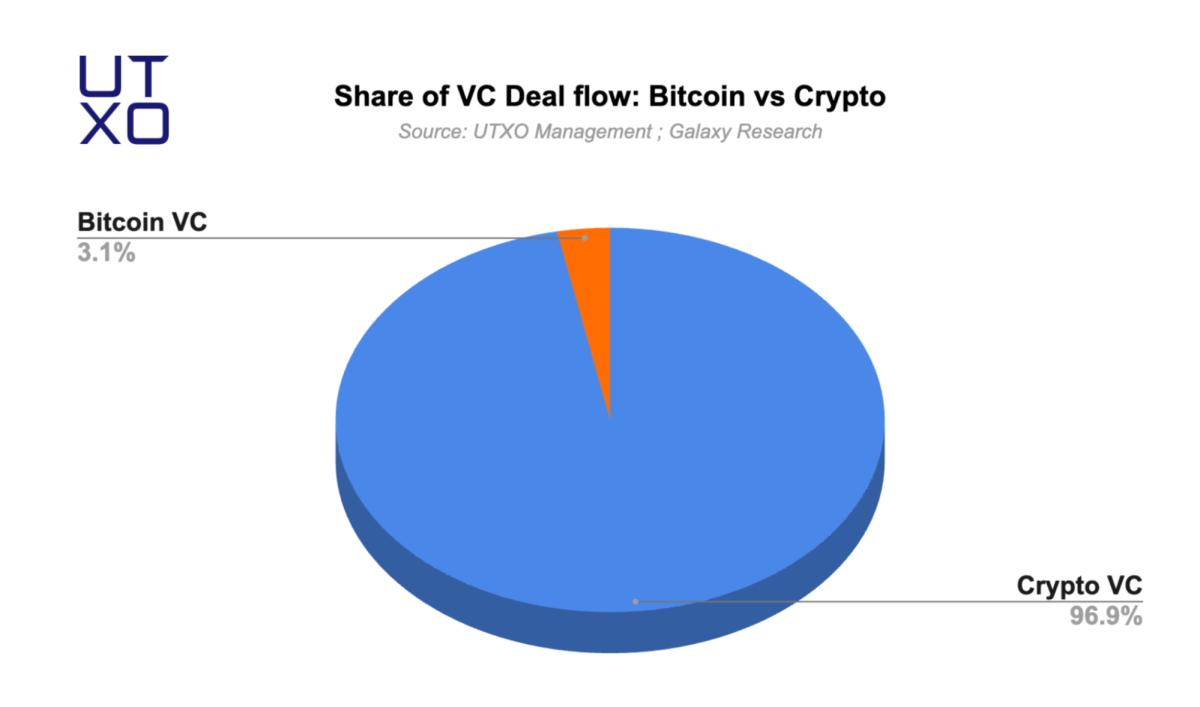
While this is a good sign for the space, Bitcoin investments only represented 3.1% of total deal flow or $96.4M in Q2 2024 while Bitcoin market capitalization constitutes above 55% of the whole crypto market.
We believe that this trend will quickly reverse as the nature of the asymmetric opportunity that Bitcoin Defi / Infrastructure represents becomes impossible to overlook. One possible explanation for the current lag in Bitcoin VC funding is that technical knowledge of Bitcoin mechanics is not as equally distributed among VCs as it is for the rest of crypto. Bitcoin analysts are few in number and the Bitcoin space has been historically closed to VCs as the lack of programmability of Bitcoin hindered its attractiveness. We also expect this to change soon as the incentive to understand the ins and outs of Bitcoin in a less crowded market will bring additional technical talent (developers included).
3. We’ve got the Alpha. Henry Elder from UTXO highlighted during Alpha Day all the ways that traditional investors should think about deploying on-chain Bitcoin capital. Some takeaways:
BTCfi is in its infancy and can be broadly organized into 3 categories: sidechains, Layer-2 chains and metaprotocols.
Sidechains are currently much simpler to launch than true Layer 2s, so it’s no surprise that the sidechain landscape is the most developed and mature BTCfi ecosystem, as the products and tools have already been developed over the past several years on Ethereum. These ecosystems also benefit from the highly developed security auditing infrastructure that already exists for Ethereum and its associated L2s.
Layer 2s: Other than Lightning Network, these products are largely still in the development stage and each implement unique and novel technical solutions to link security to Bitcoin.
Bitcoin metaprotocols that use the bitcoin chain directly and are the most bitcoin-native classification. They use bitcoin-native assets and the relevant details of their operations are encoded directly into bitcoin blocks, although they must be decoded using custom indexers. Arch Network is an example of a metaprotocol that supports BTCfi applications, but Ordinals, BRC-20s, and Runes are also metaprotocols, they simply support BTCfi assets.
The only real Layer 1 option to build on in the past has been Ethereum and a few other blockchains. Bitcoin now offers an alternative that is economically more secure, credibly neutral, and potentially offers superior technological security, as well, by dint of a lower attack surface than Ethereum. Legacy projects can remove billions of dollars of annual expenses and/or inflation by moving to a proof-of-stake model using BTC or an L2 directly on top of Bitcoin, while getting better security and maintaining a high degree of technological and cultural independence.
Bitcoin L2’s - The cool kids on the block?
1. L2’s were the center of attention. With no surprise, L2’s were the talk of the town in Nashville. BitcoinOS (Grail) announced their new rollup protocol by verifying a proof directly on Bitcoin (BitVMX had done something similar just a few days earlier on testnet). Bitlayer and many others were big sponsors of the conference, often hosting some of the coolest afterparties throughout the week. All of this to say, the momentum was definitely in favor of L2s (mostly sidechains as Janusz from Bitcoin Layers would be wise to insist upon). I expect this trend to grow as these projects look to onboard more projects to their platforms in the hope of building a community moat sufficiently strong to withstand the extreme level of competition in the space. However, at 80+ and counting, it became apparent that the hype would be short lived for many. People are mostly aware of the main players in Asia and the US, but the others will remain behind the fog of war unless they bring new innovations to the table. An important moment during the conference was also Cathie Wood on the main stage talking about Bitcoin L2s with Alyse Killeen. This could be a signal that larger institutional players are thinking about coming into the space (Franklin Templeton DA also held a private event with several VC firms, including UTXO).
2. Rollup teams are at the forefront of Bitcoin research. Something that became very clear to us after meeting the teams at Alpen, Bitlayer, and Citrea is the level of technical research underway in the Bitcoin space. The paradigm shift from BitVM has catapulted some of the brightest minds in the space toward exploring the frontiers of Bitcoin script and Zero-Knowledge Proofs. The work being accomplished now will likely onboard the next million users to Bitcoin, with trust assumptions that could satisfy a majority of users.
The main takeaway from those discussions was that, although the excitement around rollups is warranted, many challenges persist. In first place, the cost of posting Data Availability to Bitcoin. While this is bullish for miners, the race is on to provide the most optimal solution while preserving the ability for users to trust the least amount of intermediaries in the process (trust-minimized solutions). Another takeaway is that those teams are preparing to release new technical documents to the public, bringing new understanding of how they are planning to design bridges for these rollups.
3. Lightning aux oubliettes (An oubliette - from the French oublier, meaning 'to forget' - is a basement room which is accessible only from a hatch or hole in a high ceiling). Apologies for the clickbait title, but for all intent and purposes, Lightning was effectively memory-holed from everyone during the conference as people focused all their attention on Trump and new shinier objects (sidechains). Alex B from Bitcoin Magazine raised the issue as he was speaking during Alpha Day “I don’t think I’ve heard one person mention Lightning yet”.
Forgotten maybe for a few days, but certainly not dead. Once fees spike again (this is not an if but a when) I’m certain that Lightning will be at the center of every discussion again (“Can I get some of that inbound liquidity bro”).
In any case, the Lightning space continues to grow and improve, slow and steady style. Just before the conference, Lightning Labs announced (finally) the release of Taproot Assets on Lightning. My reaction to the announcement:
Lightning-fast, trustless swaps, natively on Bitcoin (producing Yield for nodes). People always say that being too early is the same as being wrong, but in the case of Lightning I believe this is the best possible outcome for capital allocators. Sure Lightning does not have the degens, it does not have the culture, but it does have the superior token standard and network effect. Many of the people I talked to at the conference tend to oppose Runes/BRC-20s to Taproot Assets, I think they are complementary. Precisely because one has the community, and the other has the means to offer that community huge cost savings and faster transaction settlement (in a completely trustless way).
Therefore, the major takeaway for me was that investing at the intersection of Runes/Bitcoin native assets and Lightning infrastructure will become very powerful as demand will naturally flow toward these projects (Joltz and LnFi are great examples that come to mind).
Mining - Is it even mining anymore?
1. Hashprice is no longer the key to becoming a profitable miner - it’s “we’re building an AI pilot project”. It has become apparent throughout my discussions with miners and analysts alike that the only catalyst propping up miners currently has nothing to do with mining and everything to do with capital allocation. Miners are choosing to allocate resources to AI and HPC, while investors are choosing to allocate resources to miners with the most exposure to these relatively new verticals. There are a few reasons for this shift:
Post halving, miners are struggling to maintain attractive margins as transaction fees generated from Ordinals and Runes have been (so far) disappointing. This has led many to consider alternative sources of revenue, preferably something high-margin, predictable in time, and compatible with existing infrastructure. AI is the perfect fit.
Markets are also generously rewarding miners with AI exposure as the marginal effect of hashrate procuration announcements forced miners and analysts to rethink how publicly listed companies should be valued.
While this trend, in large part attributable to Core Scientific and Iris, may appear to be waning in favor of a return to sanity, many present at the conference are betting on selling their available capacity at a premium to AI/HPC companies.
Nonetheless, other catalysts for mining growth became apparent last week, including the somewhat unexpected progress in ASIC design efficiency (Bitdeer in particular targeting 5J/TH in 2025) and the return of institutional financing for miners led by Cantor Fitzgerald announcing a $2 Billion financing business expected to grow well beyond that. This is important because, unlike during the 2021 mining cycle where miners mostly relied on ASIC-backed loans to raise capital, capital markets have been closed to miners since then, forcing them to rely on highly dilutive ATM offerings. This announcement could be the turning point for miner financing during the 2025 cycle.
2. The Commoditization of Blockspace is becoming a reality. I had the chance to attend the launch party of Alkymia, hosted by Blockspace Media. For those not familiar with Alkymia, their newly released platform allows you to take a directional bet on Bitcoin transaction fees. This is the latest addition to a suite of tools allowing miners to stabilize their revenues while allowing exchanges, protocols, and traders to hedge transaction fee volatility risks. As blockspace becomes more valuable, the complexity of transacting on-chain will grow, giving an edge to specialized actors understanding the nuances of Bitcoin’s mempool.
Mempools were also a big topic of discussion last week as the additional programmability of Bitcoin and the introduction of Rollups could introduce some forms of MEV or MEVil to the protocol (more about this below). Understanding the potential of MEV on Bitcoin was a big concern and our investment in Rebar Labs has never made more sense. While we are still early in those discussions, general consensus among the people I talked to was that MEV on Bitcoin will be different from ETH, with less centralization risks and more accessible opportunities for all miners.
3. The spirit of Matt Corallo's speech was overlooked. Being scheduled to speak right before the future president of the United States is never an easy exercise. However, Matt laid out the most fundamental principles that make Bitcoin what it is today in a brilliant way that would deserve more attention.
In particular, his framing of the blocksize wars - in front of many thousands of listeners - was spot on. This period of Bitcoin’s history was not so much about the size of blocks as it was about the process of governance - who decides the when and what of change to the code?
The beginning of an answer was found immediately after 2017 - miners and corporations do not. The post-conference euphoria that followed BTC++ earlier this year can also serve as an exemplary answer - developers/technical commentators do not. The only stakeholders left in the Bitcoin triumvirate of governance are users, and while users ultimately have to cooperate with miners and developers to cement of change of code into the blockchain, they remain the gatekeepers of unwanted change to the protocol. Bitcoin is not the code, it’s not the blockchain, it’s not even the currency - Bitcoin is a consensus among users.
So, after more than 22,000 people showed up in Nashville to learn more about Bitcoin, what did we learn from them?
Talking with some Nashville natives and international visitors, here’s what I could gather:
Change is exciting and most people have a favorable view of recent proposals supposed to bring additional functionality to Bitcoin. Most don’t understand what they could change or how they work. Educational content that is accessible to everyone is sorely lacking.
UX is the number one concern that always comes up in some sort of fashion. I’m mainly deriving this from trying to orange-pill Uber drivers (I think they may hate us now!) and restaurant/bar staff. Most people know Bitcoin, have heard of it, and have bought some before. The most common thing was people holding it on mobile-focused platforms like Cash App and did not understand how to request a deposit to their address (Lava has a great wallet making Bitcoin more accessible to users). Above everything else, I think the next upgrade to Bitcoin should make it easier for people to self-custody their bitcoin - which is coincidentally what is needed for them to later interact with L2s and apps. I do believe that focusing on infrastructure investment will be paramount this cycle.
I hope you like this recap. If you are a Bitcoin Builder or an investor interested in learning more about what we do at UTXO, please reach out to us on X or directly on our website.
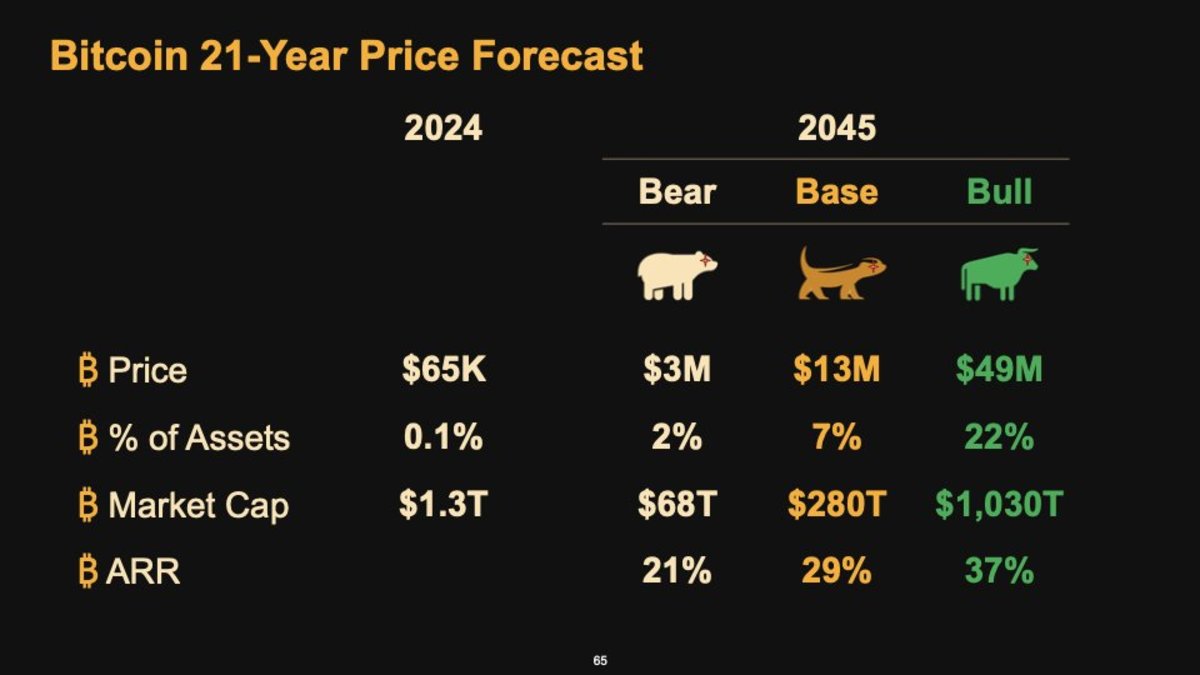
To end on a positive note, let’s not forget to highlight some of the hopium math presented by Michael Saylor during the conference, predicting a BTC price of $13M by 2045. You’re daily reminder that you’re probably not bullish enough.
BTC Inc., the leading provider of Bitcoin-related news and events, is excited to announce that after this year's successful Bitcoin 2024 event, which brought over 22 thousand attendees to Nashville, The Bitcoin Conference, the world’s largest and most prestigious gathering of the Bitcoin industry, will take place in Las Vegas from May 27-29, 2025. The decision to move the conference to Las Vegas underscores the organizers’ efforts to celebrate Bitcoin in one of the fastest-growing, forward-thinking, and Bitcoin-friendly cities in the world.
“We’re excited to welcome The Bitcoin Conference to Nevada in 2025,” said Joe Lombardo, Governor of Nevada. “The decision to move this historic event to Las Vegas not only highlights our state’s burgeoning position as a major financial and technological hub, but also our passion for welcoming innovators to our state.”
In addition to attending a vast array of conference panels and sessions, attendees will have the opportunity to participate in valuable networking and community building events, experience leading-edge technology showcases, and hear insights from policy leaders, business executives and celebrities across the Bitcoin industry.
“Las Vegas has experienced an incredible transformation over the last few years, establishing itself as a hub for entrepreneurship, technological innovation, and economic growth,” said David Bailey, CEO of BTC Inc. “Under the leadership of Mayor Goodman and Governor Lombardo, the city has also embraced the Bitcoin community with open arms. Accordingly, we believe that Las Vegas is a natural and obvious fit for The Bitcoin Conference, and we can’t wait to celebrate the continued acceleration of Bitcoin with the local community.”
As anticipation builds for the upcoming Bitcoin 2025 in Las Vegas, tickets are available for purchase on the official conference website. Interested individuals and organizations are encouraged to secure their spots early, as demand is expected to be unprecedented.
For sponsorship opportunities, media inquiries, or further information about The Bitcoin Conference, please contact us or visit https://b.tc/conference/2024.
About The Bitcoin Conference:
The Bitcoin Conference is the world's largest and most influential gathering of cryptocurrency enthusiasts, professionals, and thought leaders. With a commitment to fostering Bitcoin adoption and exploring the latest developments in the industry, the conference serves as a catalyst for innovation, collaboration, and education. Founded in 2019, the conference has grown into a global phenomenon, attracting attendees from across the world.
Bitcoin Magazine is owned byBTC Inc, which also owns and operates the world’s largest Bitcoin conference, The Bitcoin Conference.
Sriram Bhargav Karnati believes that top-notch security and usability are not mutually exclusive when it comes to managing your bitcoin.
So, he and his co-founders at Theya have built a multsig bitcoin vault — a mechanism that requires multiple participants to sign off on a Bitcoin transaction — that users can conveniently manage from their mobile devices.
“Our mission is to make self-custody easy for everybody,” said Karnati.
“If you look at all the $1 trillion companies — all the big tech companies: Apple, Google, Facebook — they all have brilliant products that everyday people can use. But if you look at Bitcoin, you don't have a product that's super easy for everybody to use without having to become a security engineer or have technical expertise,” he added.
“[We] want to really make it super simple to onboard people and make long-term storage super convenient.”
Combining Karnati’s background in building consumer products for major companies like Google and Robinhood with his deep understanding of Bitcoin, it seems there’s perhaps no better person for the job of bringing multisig Bitcoin vaults to the masses.
A Silicon Valley All-Star Shifts To Bitcoin
Growing up in Bombay, Karnati dreamed of working in Silicon Valley.
He got the opportunity in 2014 when he began working at Google, where he contributed to a number of the company’s products.
“At Google, I didn't work on just one team,” recounted Karnati.
“I touched almost all products that you use: Google Search, Google Shopping, Google Ads — everything,” he added.
“My biggest lesson from that was ‘How do you build the system from the ground up and scale it to billions of users?’ And also ‘How do people think about using a product?’”
By 2021, Karnati found himself at another prominent Bay Area-based tech company, Robinhood.
At Robinhood, Karnati learned about the intersection of money, finance and technology, paying close attention to what the company got right when it came to user experience.
“When I worked at Robinhood, one of my biggest lessons was ‘How do you take complex financial instruments and make them super simple?’” explained Karnati. “[We were] basically giving access to everybody to join finance.”
Karnati has taken these lessons he learned in Silicon Valley and is now applying them to Bitcoin self-custody.
He knows that if Bitcoin is going to scale the way it was intended to — with users holding bitcoin in self-custody — then it has to become easier to use a non-custodial bitcoin wallet or vault.
Enter Theya — dynamic and secure solution to bitcoin self-custody.
How Theya Works
Theya’s vaults employ a 2-of-3 multsig setup, which means that two of the three private key holders have to sign off on sending bitcoin from the vault for the transaction to occur. Theya holds one of the keys while the user(s) hold the other two.
What’s unique about Theya is that its first multisig solution that doesn’t require the use of a hardware wallet — devices that Karnati believes are intimidating to newer bitcoin users.
“Mobile multisig is for people who don't have a hardware wallet, but still want to do self-custody with more than a single-sig [device],” explained Karnati.
“You can create a family wallet with you and your spouse. That type of product didn't exist before Theya,” he added.
“[They can] get started with multisig, and, as they accumulate more and more bitcoin, they can slowly upgrade to a hardware wallet and create a cold storage [setup].”
For this service, Theya charges an annual fee of $199.
That said, Karnati and the team at Theya are aware that not everyone is going to opt for a multisig setup right away, especially one that comes with a price tag attached.
Given Theya’s mission to onboard as many people to self-custody as possible, Karnati explained that Theya provides a free non-custodial wallet option, as well.
“The single-sig mobile wallet is free,” he said, “and you can create as many wallets as you want.”
Karnati added that the free single-sig offering is also compatible with hardware wallets. For example, you can use the Theya app as an interface for any of the hardware wallets it supports — including Ledger, Trezor, ColdCard and Foundation devices.
But who would invest in a company that gives part of its product away for free in efforts to fulfill its mission?
One of the most prominent venture capital (VC) firms in the broader crypto and tech space — Y Combinator — that’s who.
Why Y Combinator?
To get Theya off the ground, Karnati and his co-founders accepted funding from Y Combinator, well-known for helping to financially accelerate startups in the broader crypto space — startups that often issue their own crypto tokens — as opposed to Bitcoin-only startups.
So what piqued Y Combinator’s interest in Theya?
“Y Combinator doesn't really invest based on the idea,” said Karnati. “They invest based on the founder’s background.”
Given that Theya’s two other founders — Smeet Bhatt and Vikas Choudary — also have impressive résumés and extensive experience working in tech, logistics and finance, it isn’t hard to imagine why Y Combinator was interested.
However, Y Combinator appreciated more than just the backgrounds of Theya’s founders.
“They also love our mission,” said Karnati.
“There’s a clear space for us to build. Everybody wants to make quick money. Everybody wants to create a token and stuff like that, and they thought ‘These guys are doing something different and filling a gap where you don't really have big products,’” he added.
Karnati’s Bitcoin Conviction
Considering that Karnati has the chops as a developer to work for seemingly any technology company, one has to ask: Why focus on Bitcoin?
“I read Satoshi’s whitepaper in 2014 and kind of understood it,” Karnati recalled. “Then, I read Andreas’ Mastering Bitcoin to understand better how it works.”
But it wasn’t Karnati’s theoretical grasp on Bitcoin that made him a believer.
“Then, I bought a little bit of Bitcoin and made a transaction on-chain,” he said.
“That's when I was like, ‘Wow, like this is real.’ I was able to move my own money permissionlessly. It was so obvious that this has to be the future of money,” he added.
When Karnati juxtaposed this experience in transacting with bitcoin with his experience in sending international remittances from South Korea, where he lived while working for Samsung, to India he experienced one of Bitcoin’s main value propositions — cheap and fast remittances.
“There was a lot of KYC, a lot of verification and it was super slow,” said Karnati of the process of sending a remittance payment via the traditional financial rails. “Sometimes there were some failures, as well, and it was very costly — there was a 1.5% fee on top of foreign exchange fees.”
After this experience, Karnati also learned about and experimented with other blockchains, only to come back to Bitcoin once he became more fully aware of one of bitcoin’s other main attributes — a store of value.
“I realized the most important thing is the store of value,” said Karnati regarding what separates bitcoin from other digital assets.
This is part of what prompted him to create a product that made storing the private keys to that store of value easier and safer.
What’s Next For Theya?
Aside from providing users with a premier multisig vault experience, Karnati and the team at Theya have further aspirations for their app.
“Payments is definitely an area into which we want to grow,” said Karnati. “We want to make it easy for merchants to accept payments and for someone to offer a subscription service.”
However, he added that integrating Lightning isn’t next on the docket for Theya.
Karnati and his team are more intent right now on introducing an exchange into the app so that users can purchase bitcoin within the app and send it directly to cold storage. Part of his motivation for including such a feature comes from taking note of the shortcomings of other Bitcoin and crypto exchanges in the space, including one for which he used to work — Robinhood.
“Some of our users have a Coinbase or Robinhood account,” explained Karnati.
“[These platforms] have limits to withdrawals, which is a hassle for [users]. With what we’re making, you can buy directly to the self-custodial vault,” he added, proving the point that convenience and top-notch security can co-exist in one app.
In a significant legislative move, Russian lawmakers have passed a bill permitting businesses to use Bitcoin and other cryptocurrencies in international trade, according to a report by Retuers. This development is part of Russia's strategy to circumvent Western sanctions imposed following the invasion of Ukraine. The new law, expected to take effect in September, aims to address delays in international payments, particularly with key trading partners like China, India, and the UAE.
JUST IN: 🇷🇺 Russian law makers passes bill allowing businesses to use #Bitcoin and cryptocurrencies in international trade — Reuters pic.twitter.com/yFExWcIG9k
Central bank Governor Elvira Nabiullina, a proponent of the law, announced that the first cryptocurrency transactions will occur before the year's end. The central bank will establish an "experimental" infrastructure for these payments, with further details pending.
"The risks of secondary sanctions have grown," Nabiullina stated. "They make payments for imports difficult, and that concerns a wide range of goods."
The legislation also includes regulations on cryptocurrency mining and the circulation of other digital assets but maintains the ban on cryptocurrency payments within Russia. The central bank highlighted that payment delays have caused an 8% drop in Russian imports in the second quarter of 2024.
Despite efforts to shift to trading partners' currencies and develop an alternative BRICS payment system, many transactions still rely on dollars and euros via the SWIFT system, risking secondary sanctions. Nabiullina emphasized that these sanctions have complicated import payments, extending supply chains and increasing costs.
This decision by Russian lawmakers aims to mitigate the economic challenges posed by sanctions and ensure smoother international trade operations. Anatoly Aksakov, the head of the Duma lower house of parliament, reportedly told lawmakers, "We are taking a historic decision in the financial sphere" by passing this legislation.
Senator Cynthia Lummis (R-WY) has announced plans to introduce legislation directing the U.S. government to accumulate 1 million Bitcoin, which would be worth over $68 billion at current prices.
Speaking at the Bitcoin 2024 conference in Nashville, Lummis said the bill would have the U.S. Treasury purchase Bitcoin over a 5-year period as a strategic reserve asset to fortify the dollar. She likened it to the government's strategic petroleum reserve.
"We know from modelling the numbers and past experience with Bitcoin that it is capable of being an absolute game changer for the mess the United States has gotten itself into with its debt and its deficits," says Lummis.
The senator said the government would self-custody the Bitcoin across various geographic locations. The assets could only be used to pay down the national debt and would need to be held for at least 20 years.
Lummis has been one of the leading Bitcoin advocates in Congress. She believes acquiring Bitcoin will help stabilize the dollar's value and counter inflation. The national debt recently surpassed $35 trillion.
Her proposal follows former President Donald Trump's endorsing the idea of a U.S. Bitcoin reserve at the Nashville conference. Trump said he would never sell any of the government's 210,000 bitcoin holdings.
Independent presidential candidate Robert F. Kennedy Jr. also called for purchasing 500 bitcoins daily until accumulating a 4 million Bitcoin reserve.
While Lummis admits her legislation is unlikely to pass before the 2024 elections, she believes the growing political interest in Bitcoin reserves reflects a paradigm shift. Bitcoin has become a major campaign issue, with both parties courting the burgeoning industry.
Lummis bill represents the most aggressive government adoption of Bitcoin proposed yet. Though its prospects remain uncertain, the move would legitimize Bitcoin as an economic asset.
Lummis said she is "optimistic" that other Bitcoin-focused bills could still pass this year as Bitcoin moves closer to the political mainstream.
This past Saturday, former president Donald Trump addressed the Bitcoin 2024 conference in Nashville, Tennessee, expounding upon the crypto and bitcoin policies likely to be implemented as part of a likely future Trump administration. Speaking in front of a banner emblazoned with the logo of Xapo bank, an institution which hopes to serve as a global bridge between bitcoin, the U.S. dollar and stablecoins, Trump’s speech revealed a policy vision that would integrate those three in order to “extend the dominance of the U.S. dollar to new frontiers all around the world.”
Talk of a threatened dollar has been circulating for years, with the petrodollar system now having ended and increasingly influential power blocs seeking alternatives to the dollar as a reserve currency. However, Trump – per his recent speech – seems poised to employ bitcoin as a sink for out-of-control U.S. government debt and to unleash the expansion of digital dollar stablecoins, which are already quietly dollarizing numerous countries in the Global South as the consequences of Covid-era fiscal policies continue to decimate the purchasing power of the 99% globally.
Trump promised, among other things, to “create a framework to enable the safe, responsible expansion of stablecoins […] allowing us to extend the dominance of the U.S. dollar to new frontiers all around the world.” He then asserted that, as a result of his future administration’s embrace of dollar stablecoins, “America will be richer, the world will be better, and there will be billions and billions of people brought into the crypto economy and storing their savings in bitcoin.” Bitcoin mining was also a later focus of the speech, with Trump claiming that “America will become the world’s undisputed bitcoin mining powerhouse.” This would further entrench something else touched on by Trump, that “the United States government is among the largest holders of bitcoin.”
He then discussed his views on the relationship between bitcoin and the dollar: ¨Bitcoin is not threatening the dollar. The behavior of the current U.S. government is really threatening the dollar.¨ However, the “threatening” behavior to which Trump refers, the perpetual money printing of the Federal Reserve system, has been the policy of every U.S. president for roughly the past century, with Trump himself being no exception. Indeed, under Trump, more money was printed than under any president in history, as the Covid-19 crisis “unleashed the largest flood of federal money into the United States economy in recorded history.” With trillions printed to enable the government’s policy of lockdowns and government purchases of experimental vaccines, the U.S. national debt grew by $8.18 trillion under Trump, keeping up with the pattern of rapid debt expansion set by his predecessor Barack Obama – who grew the debt by $8.34 trillion during his eight years in office.
Thus, any policy that unites bitcoin and the dollar – whether under Trump or another future president – would most likely be aimed at enabling the same monetary policy that currently threatens the dollar. The most likely outcome under Trump, as outlets like CNBChave speculated, would be making bitcoin a reserve asset and, as a consequence, a sink for the inflation caused by the government’s perpetual expansion of the money supply. Ironically, bitcoin would then become the enabler of the very problem it had long been heralded as solving.
Not only that, but bitcoin would then become the anchor that would allow the U.S. government to weaponize the dollar against economies where local currencies fail to withstand the pressures of an increasingly unstable economy, effectively supplanting the local currency with digital dollars. This phenomenon, already under way in countries like Argentina, brings with it significant opportunities for the U.S. government to financially surveil the “billions and billions of people” to be brought onto dollar stablecoin platforms, some of which have already onboarded the FBI and Secret Service and frozen wallets at their request.
Considering that “private” stablecoin platforms are already so intertwined with a government known to warrantlessly surveil civilians both domestically and abroad, the surveillance concerns are analogous to the surveillance concerns around central bank digital currencies (CBDCs). In addition, with stablecoins being just as programmable as CBDCs, the differences between stablecoins and a CBDC would revolve largely around whether the private or public sector is issuing them, as both would retain the same functionality in terms of surveillance and programmability that have led many to view such currencies as threats to freedom and privacy. Thus, Trump’s rejection of CBDCs but embrace of dollar stablecoins on Saturday shows a rejection of direct digital currency issuance by the Federal Reserve, not a rejection of surveillable, programmable money.
So the question remains, why wouldn’t the U.S. government just make a retail-facing CBDC? For starters, there are likely more limitations for a public sector entity on who and what they can restrict on their platforms. However, the main reason is mostly an economic one: they need to sell their debt to someone else to perpetuate the U.S. Treasury system.
Stable Demand For U.S. Debt
In order for an incoming Trump administration to successfully meet the demands of their congressional budget while also servicing of our compounding $35 trillion in debt already owed, the Treasury needs to find a willing buyer for that newly issued debt. In the past 18 months, a new high volume net buyer of this debt has appeared in the cryptocurrency industry: stablecoin issuers. Stablecoin issuers such as Tether or Circle have purchased over $150 billion of U.S. debt –– in the form of securities issued by the Treasury –– in order to “back” the issuance of their dollar-pegged tokens with a dollar-denominated asset. For some perspective on the absolutely astounding amount of volume these relatively young and relatively small businesses have gobbled up of U.S. debt, China and Japan, historically the U.S.’ largest creditors, hold just under and just over $1 trillion, respectively, in these same debt instruments. Despite only existing for a decade, and despite only surpassing a $10 billion market capin 2020, this leaves Tether alone at over 10% the Treasuries held by either of the U.S.’ largest nation-state creditors.
Using stablecoins to help mitigate the U.S. debt problem have been circulating among Republicans for some time. Despite his “neveragain” stance on Trump, former Speaker of the House Paul Ryan articulated this exact sentiment in a recent op-ed with The Wall Street Journal titled “Crypto Could Stave Off a U.S. Debt Crisis.” Ryan claims that “stablecoins backed by dollars provide demand for U.S. public debt” and thus “a way to keep up with China.” He speculated that “the [debt] crisis is likely to start with a failed Treasury auction” which in turn leads to “an ugly surgery on the budget.” The former Speaker predicted that “the dollar will suffer a major confidence shock” and as a result asks, “What can be done?” His immediate answer is to “start by taking stablecoins seriously.” Dollar-backed stablecoins are arriving as “an important net purchaser of U.S. government debt,” he notes, with stablecoin issuers now the 18th largest holder of U.S. Debt. Ryan goes on to say that “if fiat-backed dollar stablecoin issuers were a country,” that nation “would sit just outside the top 10 in countries holding Treasurys,” still less than Hong Kong but “larger than Saudi Arabia,” the U.S.’ former partner in the petrodollar system.
As this industry would expand and be deregulated under a future Trump presidency, stablecoins – including PayPal’s relatively new stablecoin, PYUSD –– could “become one of the largest purchasers of U.S. government debt” and importantly, a “reliable source of new demand” for Treasuries. Paul notes the oft-discussed trend of de-dollarization putting pressure on the timeframe for this industry expansion, saying “if other countries are successful at bolstering their currencies’ influence while dumping Treasury debt, the US will need to find new ways to make the dollar more attractive,” pointing to “dollar-backed stablecoins” as “one answer.”
In the U.S., Retail CBDCs Are A Red Herring
On Saturday, Trump once again expressed a desire to ban government-issued digital currency, a statement popularized by other candidates in the field to great applause by freedom loving citizens across the country and across party lines. The idea of a central bank digital currency, or CBDC, is obviously Orwellian, and publicly discussed concerns of a government using this digital authority to control its citizens are easily found. So, while the public has generally feared the direct issuance of some form of retail CBDC due to, for example, surveillance or seizure concerns from a government issuer, few realize a private company issuer can do much the same –– and perhaps go even farther.
As our economy and the dollar become further digitized, having left behind many of the taken-for-granted privacy qualities of physical notes, our attention has been purposefully directed towards the idea that Orwellian digital currencies are limited to those issued by a central bank. Meanwhile, the astronomical growth of the private stablecoin sector, and the banks behind them, have remained largely unnoticed. The state understands this to some degree and the push to ban central bank digital currencies, or CBDCs, has been acknowledged from members of both political parties of the United States. Yet, the stablecoin industry was left undisturbed for years, maturing to over $150 billion issued, mainly in the form of programmable, seizable, and censorable ERC-20 tokens issued on Ethereum. Much of the infrastructure of Ethereum is dominated by JPMorgan, a bank that has – among other things – financially censored critics of the government’s Covid-19 response. The companies behind prominent stablecoins, such as Circle’s USDC – backed by BlackRock, have bragged about the programmability functionalities of their stablecoins.
In the case of the dollar stablecoin Tether (USDT), Howard Lutnick, the CEO of Cantor Fitzgerald which holds Tether’s Treasuries, has stated his affinity for the company by making reference to Tether’s recent trend of blacklisting retail addresses flagged by the U.S. Department of Justice. “With Tether, you can call Tether, and they’ll freeze it.” On Saturday, Trump mentioned Lutnick by name in his speech, calling Lutnick – one of the longest standing, top traders of U.S. government debt – “incredible” and “one of the truly brilliant men of Wall Street.”
Last October, Tether froze 32 wallets for alleged links to terrorism in Ukraine and Israel. The next month, $225 million was frozen after a DOJ investigation alleged that the wallets containing these funds were linked to a human trafficking syndicate. During December 2023, over 40 wallets found on the Office of Foreign Assets Control’s (OFAC) Specially Designated Nationals (SDN) List were frozen by the stablecoin issuer. Paolo Ardoino, the CEO of Tether, explained these actions by stating that “by executing voluntary wallet address freezing of new additions to the SDN List and freezing previously added addresses, we will be able to further strengthen the positive usage of stablecoin technology and promote a safer stablecoin ecosystem for all users.”Ardoino has previously claimed that Tether froze around $435 million in USDT for the U.S. Department of Justice, the Federal Bureau of Investigation and the Secret Service. He also explained why Tether, which was intimately connected to the now defunct crypto exchange FTX, has been so eager to help the U.S. authorities freeze funds – Tether is seeking to become a “world class partner” to the U.S. to “expand dollar hegemony globally.”
This year, little has changed, with Tether promising to freeze assets tied to Venezuela’s state-run oil company, which is under U.S. sanctions, in April. As a consequence, Tether has made it clear that it plans to function as a tool of U.S. foreign policy. Given that the U.S. military has – in the past – defined institutions like the World Bank and IMF as “financial weapons” wielded by the U.S. government, it seems an almost certainty that Tether is viewed as yet another addition to the U.S.’ financial arsenal. This is especially true when one considers that Tether recently integrated Chainalysis, heavilybacked by the CIA’s In-Q-Tel, into its platform in May and then hired Chainalysis’ chief economist as Tether’s economics head earlier this month.
The stablecoin ecosystem, where U.S. dollar-pegged stablecoins like Tether dominate, has become increasingly intertwined with the greater U.S. dollar system and – by extension – the U.S. government. The DOJ has the retail-facing Tether on a leash after pursuing the companies behind it for years and now Tether blacklists accounts whenever U.S. authorities demand. The Treasury benefits from the mass purchasing of Treasuries by stablecoin issuers, with each purchase further servicing the federal government’s debt. The private sector brokers and custodians that hold these Treasuries for the stablecoin issuers benefit from the essentially risk-free yield. And the dollar itself furthers its effort to globalize at high velocity in the form of these digital tokens, helping to ensure it remains the global currency hegemon.
Up until relatively recently, this perfectly reasonable fear of loss of privacy and property rights innate to centralized money had been placed solely on money directly issued by the state and not on how stablecoins could be used in similar ways. Trump may have publicly rejected CBDCs as a campaign promise, but he intends to allow these private stablecoins to proliferate, pushing dollar hegemony across the globe and servicing our country’s debt. After Trump’s illuminating Bitcoin 2024 speech, the suddenly too-big-to-ignore ¨private bank digital currency¨ elephant in the room has been painted bright orange.
Building The Bitcoin-Dollar
Trump’s speech didn’t just describe a new regulatory environment for stablecoins, but simultaneously painted a picture of the state never selling its currently held bitcoin and that people around the world would keep their savings in bitcoin the asset. But why would a leading candidate for the highest office in the country want there to be a new reserve asset outside of the Treasury system? While many have presumed bitcoin is competing with the dollar system, Trump – as noted earlier – painted a different picture on Saturday. “Those who say that Bitcoin is a threat to the dollar have the story exactly backwards. I believe it is exactly backwards. Bitcoin is not threatening the dollar.”
The idea of The Bitcoin-Dollar is a parallel to the petro-dollar system, which was upheld from the gold window closing via the Nixon shock in 1971 until only somewhat recently. By creating a de facto monopoly on the in’s and out’s of oil to U.S. dollars, the U.S. was essentially able to re-peg their inflating dollar to an ever-demanded energy commodity, and create a mass buyer of dollars. Every country that wanted to industrialize needed oil to do so, and thus every country that wanted to compete on the world stage first needed to buy some dollars.
Bitcoin, too, is an energy commodity, and the U.S. dollar system has once again established a de facto monopoly on the volume of bitcoin sales across the globe, not to mention that the country also holds more bitcoin on its balance sheet than any other nation in the world. The U.S. could easily print $35 trillion dollars in freshly issued Treasuries and pay off its debt, especially now that it has found a buyer with an insatiable demand in the aforementioned stablecoin issuers, but the inflationary effects would be catastrophic on the purchasing power of the dollar and, thus, the net purchasing power of the U.S. economy.
This is where Bitcoin comes in. Bitcoin is the only commodity to break the pressures of increasing demand on inflating supply. For example, if gold doubles in price, gold miners can send double the miners down the shaft and inflate the supply twice as fast, thus decreasing demand and thus eventually decreasing the price. Yet, no matter how many people are mining bitcoin, no matter how high the hash rate increases this month, the supply issuance remains at, as of April 2024, 3.125 bitcoin per block. This capped eventual supply of 21 million –– set via a disinflationary rate of token issuance hardcoded in the protocol within Bitcoin’s monetary policy at network launch –– allows the U.S. to massively inflate the dollar into this demand inelastic energy commodity without, for example, making nationstate-holders of gold wealthy or oil-rich nations even richer. As the price of bitcoin goes up worldwide, the large reserves held within the borders of the U.S. will increase the relative wealth of the country.
How can we continue to keep up demand for the dollar while still pumping the money supply to pay off our compounding debts?…By creating an infrastructural on-ramp to Satoshi’s protocol that is denominated in dollars, in effect, we have recreated the same, ever-present demand for an inflating supply of dollars demonstrated in the petrodollar system. By expanding the Tether market cap to [$115 billion] during the first dozen-or-so years of Bitcoin’s life, when [94%] of total supply was issued, the U.S. market made sure the value being imbued into the now-disinflationary protocol would forever be symbiotically related to the dollar system…
Tether isn’t simply “tethering” the dollar to bitcoin, but permanently linking the new global, permissionless energy market to the United States’ monetary policy. We have recreated the petrodollar mechanisms that allow a retention of net purchasing power for the U.S. economy despite monetary base expansion.
The regulatory environment, both current and oncoming, completes the bitcoin-dollar mechanism by requiring banking groups to perpetuate the U.S. Treasury system, via novel capital requirements, to service both the U.S. government’s current budget and the ballooning interest on the $35 trillion debt we hold already.
The Public Sector Meets The Private
As American commercial banks continue to integrate volatile digital assets such as bitcoin, the need to ensure the retail public that liquid liabilities for digital commodities exist creates a unique opportunity to tilt regulation in the favor of stimulating demand for dollars. Incoming regulation such as Basel III, floated by Trump-appointee Jerome Powell, would require any bank wanting to hold bitcoin, other digital assets, or even gold, to also be required to hold an equal-part dollar to dollar-denominated valuation of their investments. The adoption of this international capital requirement would force a net-demand for dollars in the U.S banking system, despite a high monetary inflationary environment. For banks or registered investment vehicles looking to offset inflationary effects by purchasing alternative reserve assets such as bitcoin, this regulation would mean that an increase of valuation of bitcoin in a dollar-pair would also increase the need for dollar liabilities on their balance sheet. Want to run a responsible bank and meet capital requirements while also holding bitcoin on your balance sheet? Then, you better be prepared to also hold a lot of dollars. The downstream effect of Basel III will create permanent demand for dollars, even in a “hyperbitcoinization” environment. Quite likely especially in a ¨hyperbitcoinization¨environment, and arguably by design.
Trump will surely lean on his private sector banker friends in this administration as he did the last time. Indeed, the Trump administration was responsible for implementing the BlackRock-designed “Going Direct Reset.” That “reset”, as explained by John Titusfor Catherine Fitts’Solari Report, began in August 2019 when Larry Fink’s BlackRock presented a proposal to central bankers for “dealing with the next downturn,” which instructed the Fed to “go direct.” In short, “going direct” marked a major departure from past crisis responses of the Fed as it means, per BlackRock, “finding ways to get central bank money directly in the hands of the public and private sector spenders,” as opposed to just public, in such a way that it represented “permanent monetary financing of a fiscal expansion.” As Titus notes, the BlackRock plan was essentially post-2008 quantitative easing, or QE, but “private sector spenders” were added “to the list of ‘public’ parties who received money under QE previously.”
BlackRock’s proposal was fortuitously timed, as the “next downturn” followed less than a month later, when the repo market became highly unstable, leading to the New York Fed to begin intervening in that market beginning on September 17, 2019. The Fed, between September 2019 and March 2020, embarked on the rapid expansion of the size of its balance sheet, as it had done during the 2008 financial crisis, and began implementing BlackRock’s August 2019 proposal by “going direct.” The situation became worse when the stock market tanked in mid-February 2020 and the Fed increased asset purchases to over $150 billion. However, the stock market did not respond as the Fed had hoped. On March 11, 2020, the WHO declared Covid-19 a pandemic. That very same day, as John Titus meticulously documents in his piece on “Going Direct”, “the Fed’s asset purchases immediately went into high gear.”
Once the pandemic was declared, BlackRock’s Larry Fink was in constant communication with Trump’s Treasury Secretary Steve Mnuchin and the Fed’s Jerome Powell, also a Trump appointee. According to records obtained by The New York Times, BlackRock and Fink referred to the Trump administration’s Covid fiscal response as “the project” that Fink and his firm were “working on together” with the public sector. Given Titus’ work, it seems obvious that “the project” referred to the “Going Direct Reset,” which – as noted above – began to be implemented well before a pandemic was declared but was able to be conveniently disguised as a policy response to Covid-19.
Trump himself also boasted that, soon after the pandemic was declared, he had tapped “a secret weapon for advice: Larry Fink.” Before Trump was president, BlackRock and Fink had managed Trump’s investment portfolio for many years and Trump was a major investor in BlackRock’s Obsidian Fund. At one White House event in 2017, Trump stated “Larry did a great job for me. He managed a lot of my money. I have to tell you, he got me great returns.” Fink, who has described himself as a “proud Globalist,” was also appointed by Trump to serve on his Strategic and Policy Forum, which was designed “to provide direct input to the President from many of the best and brightest in the business world in a frank, non-bureaucratic, and non-partisan manner. One wonders if the cozy personal and financial relationship between Trump and Fink influenced his administration’s decision to implement BlackRock’s plan to “go direct.”
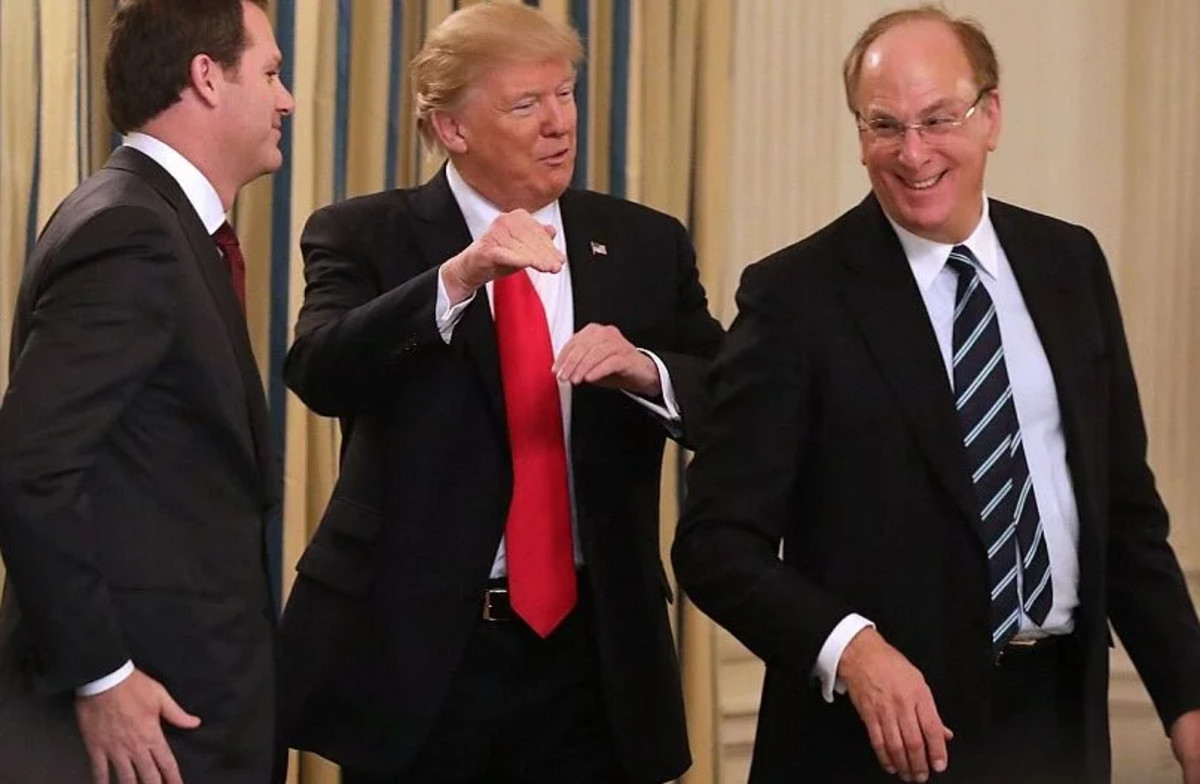
Trump (center) speaks with WalMart CEO Doug McMillon (left) and BlackRock’s Larry Fink (right) at the White House in February 2017 – Source
During 2020, BlackRock was instrumental in the distribution of the Fed’s relief efforts, or lack thereof, having been chosen as the manager of both the Primary and Secondary Corporate Credit Facilities. BlackRock rose to the occasion and used this newly-given legal authority to purchase ETFs owned by BlackRock itself: “Between May 14 and May 20, about $1.58 billion in ETFs were bought through the Secondary Market Corporate Credit Facility (SMCCF), of which $746 million or about 47% came from BlackRock ETFs.” At the time BlackRock’s role in the “recovery” was announced, one asset management executive toldThe Financial Times: “It’s truly outrageous. BlackRock will be managing a fund and deciding if they want to use taxpayer money to purchase ETFs they manage. There’s probably another 100-200 managers who could do this, but BlackRock was chosen.”
Despite being tasked with “rescuing Main Street” from the economic impacts of the Covid-19 pandemic (though really the government-induced lockdowns), BlackRock remained a private company with a profit-first plan of action motivated by their shareholders –– notably not the American public. As Titus notes, this very notion was brought up by Congress while questioning the Trump-appointee Treasury Secretary Steven Mnuchin and the Trump-appointee Fed Chair Jerome Powell on May 18, 2020: ¨The Fed has hired the firm BlackRock to serve as an investment manager for this facility. How is the Fed ensuring BlackRock is acting in the best interest of the Fed and the public?¨ All Mnuchin and Powell could muster was confirmation that BlackRock was hardly acting in the public’s interest, but rather for the benefit of the New York Fed, which despite the name, is a private bank. ¨The Federal Reserve Bank of New York (“FRBNY”) is the sole managing member of the CCF. Pursuant to the [investment management agreement], BlackRock acts as a fiduciary to the CCF in performing investment management services.¨
Under the Trump administration, BlackRock took the levers of capital creation to enrich their shareholders during a crisis, all done under the guise of a necessary solution to a viral emergency. However, BlackRock had designed this very “crisis response” plan well before Covid-19 and, critically, the Fed had begun implementing it well before Covid-19 was even declared a pandemic. The end result was a historical wealth transfer from regular Americans to a handful of billionaires. This wealth transfer, which was heavily premeditated and provably used the Covid-19 crisis as cover, should be treated as unprecedented theft from the American taxpayer; yet few Americans know that it even happened.
As previously mentioned, during Covid, BlackRock took advantage of these government lockdowns to manipulate their own ETF holdings for massive profits. BlackRock’s iSHARES spot Bitcoin ETF offering, $IBIT, is now the fastest growing ETF in history, and has on-shored more than 337,000 bitcoin since January 2024 –– making it the largest Bitcoin fund in the world –– all within the regulatory arm of the United States. Within BlackRock’s iSHARES Bitcoin Trust Form S-1 Registration Statement was their disclosure that they use Coinbase for bitcoin custody (as does the U.S. government). Also in the statement was a notice of potential conflict of interest within an affiliate of theirs acting as investment manager to a money market fund, the Circle Reserve Fund, which the dollar stablecoin issuer of USDC uses to “hold cash, U.S. Treasury bills, notes and other obligations insured or guaranteed as to principal and interest by the U.S. Treasury and repurchase agreements secured by such obligations or cash, which serves as reserves backing USDC stablecoins.” It later states that “an affiliate of the Sponsor [BlackRock] has a minority equity interest in the issuer of USDC.” The S-1 includes a line stating the “price of bitcoin may be affected due to stablecoins (including Tether and USDC), the activities of stablecoin issuers and their regulatory treatment,” all but making explicit the concerns presented in the bitcoin-dollar concept.
Would BlackRock, Trump’s former money manager, again be called upon to craft legislation during a “crisis” under a future Trump administration? History often repeats itself and it seems likely that, were similar decisions made the next time economic calamity rears its head, bitcoin could play a role in the crony capitalist response.
The Orange-pilled Orange Man
With President Biden pulling out of the race, a Trump victory in November seems more plausible than not. Trump is likely to be just as “pro-bitcoin” as he espoused on Saturday, but only in the sense that he will support bitcoin policies that support the bitcoin ambitions of his private banker friends, such as Larry Fink, who has frequently stated since his about-face on the issue that bitcoin is a “technology for asset storage” and nothing more.
The strategy recently laid out by Trump envisions a regulatory environment that would prevent a person from being “bitcoin-only”, as bitcoin, the U.S. dollar and dollar stablecoins come together to form a financial system that will please both the U.S. military-industrial complex and Wall Street in equal measure. In addition, given that Trump’s previous fiscal policy involved allowing BlackRock to essentially design and implement a premeditated plan for mass theft of the wealth of regular Americans, it is fair to assume that the risk of Trump’s promised regulatory framework enabling the same is considerable.
The government lockdowns in 2020 crushed economic demand while the Fed, Treasury, and their private partners like BlackRock used emergency resolutions to create trillions of dollars to purchase assets for pennies on the dollar. Now that economic activity has been allowed to resume, the same actors plan to hyperinflate the dollar into those assets acquired during Covid, likely enabling yet another massive wealth transfer once the “next downturn” makes itself known.
With Saturday´s speech, it seems our likely next president intends to formerly ring in a new financial system upon his commencement by delivering on his now-articulated promise to make America and the dollar “great again” with Bitcoin and private sector stablecoins.
Bitcoin is undoubtedly a financial revolution, it just may not be the one you signed up for.
This is a guest post by Mark Goodwin and Whitney Webb. Opinions expressed are entirely their own and do not necessarily reflect those of BTC Inc or Bitcoin Magazine.
Independent US presidential candidate Robert F. Kennedy Jr. made headlines at the Bitcoin 2024 conference by pledging to purchase 4 million Bitcoins for the U.S. government if elected president. Speaking to a cheering crowd, Kennedy outlined his bold plan to integrate Bitcoin into the national economy.
"I will sign an executive order directing the U.S. Treasury to purchase 550 Bitcoin daily until the U.S. amasses a reserve of at least 4 million," Kennedy declared. This would represent nearly 20% of the total Bitcoin supply.
Kennedy also said he would transfer the 204,000 Bitcoin currently held by the government into a Federal Reserve strategic reserve. He promised the cascading impact of these moves would "effectively move Bitcoin to a valuation of hundreds of trillions of dollars."
He praised Bitcoin as "the currency of hope" and a way to restore financial stability after years of poor monetary policies. "Fiat currency was invented to fund the war," Kennedy said, adding that a Bitcoin standard would eliminate incentives for military conflict.
While Kennedy is not doing very well in early polls, his full-throated embrace of Bitcoin could help him gain traction with libertarian-leaning voters. He railed against high inflation and shrinking purchasing power, issues he believes adopting a Bitcoin standard would address.
Kennedy also pledged to make Bitcoin transactions non-taxable and allow Bitcoin to be exchanged tax-free. He said Bitcoin's transparency makes it "the greatest foe of government corruption."
With Bitcoin becoming a hot topic in the 2024 race, Kennedy is clearly trying to seize the mantle as the most Bitcoin-friendly candidate. His call for a massive 4 million bitcoin reserve shows he is willing to stake out bold positions to attract the growing Bitcoin voter bloc.
Speaking at the Bitcoin 2024 conference in Nashville on Saturday, former President Donald Trump made several pledges to the Bitcoin community if elected in 2024. Most notably, Trump said he would create a strategic national reserve of Bitcoin as an economic asset.
"I pledge to the Bitcoin community that the day I take the oath of office, Joe Biden and Kamala Harris' anti-crypto crusade will be over," "The United States will be the crypto capital of the planet and the Bitcoin superpower of the world."
Trump vowed to fire SEC Chairman Gary Gensler on his first day in office and appoint a new chairman more friendly to Bitcoin and crypto. He also said the government would keep 100% of its current Bitcoin rather than auctioning it off, slowly building up a national reserve.
"Bitcoin stands for freedom, sovereignty, and independence from government coercion and control," Trump stated. "Bitcoin and crypto will skyrocket like never before if I am elected president."
The former president's remarks were welcomed by the largely libertarian-leaning audience. Attendee Andrew Campbell told Wired that he would vote for Trump this time after not doing so in 2016 or 2020. "I think we've gone too far left, and we need to snap back a little and recenter," he said.
Trump also reaffirmed his pledge to pardon Silk Road founder Ross Ulbricht on his first day in office. Ulbricht is serving a double life sentence plus 40 years without the possibility of parole. Trump claimed Bitcoin does not threaten the dollar but rather "the current U.S. government is threatening the dollar."
Following Trump's speech, Bitcoin surged over 3%, hitting its highest price in six weeks.
Independent presidential candidate Robert F. Kennedy Jr. also spoke at the conference, pledging to build a 4 million Bitcoin reserve if elected. Trump's plan does not go as far but still represents a significant embrace of Bitcoin from the Republican nominee.
With Bitcoin becoming a key issue on the 2024 campaign trail, Trump is clearly courting the growing Bitcoin and crypto wing within the GOP. Based on the enthusiastic reception in Nashville, the strategy appears effective in locking down the Bitcoin vote.
The University of Wyoming (UW) has established the UW Bitcoin Research Institute, marking the first academic institute dedicated to Bitcoin studies. Dr. Bradley Rettler, an Associate Professor of Philosophy and author of Resistance Money: A Philosophical Case for Bitcoin, has been appointed as the inaugural director, Rettler announced on the Genesis Stage at the Bitcoin 2024 Conference in Nashville.
The institute aims to elevate the quality and impact of Bitcoin research by creating faculty positions for Bitcoin research, incentivizing and rewarding good academic research on Bitcoin, encouraging young scholars to pursue Bitcoin research projects, and providing workshops on related papers and books. It will also connect researchers interested in Bitcoin and provide peer-reviewed research for journalists, policymakers, and the public.
The current state of academic Bitcoin research is not of the highest quality, so the institute aims to address these issues by creating and providing more accurate and rigorous academic studies on Bitcoin. The institute will work to ensure that high-quality, evidence-based research is accessible to all.
The University of Wyoming is strategically positioned to lead this initiative due to its interdisciplinary academic collaboration, proximity to renewable energy sources, and supportive legislative and regulatory environment. The institute will also collaborate with various university units, including the philosophy and economics departments, School of Computing, and Center for Blockchain and Digital Innovation.
Those interested in supporting this research can donate to the UW Bitcoin Research Institute here. Donations are tax-deductible and all BTC donated will be held, the official page states.
The Bitcoin 2024 conference, the largest Bitcoin event in the world, is taking place this week in Nashville with several big-name speakers, including Donald Trump, Vivek Ramaswamy, Cathie Wood, Michael Saylor and more.
The conference already had a successful first general day, during which Bitcoin leaders made major announcements. Presidential candidate Robert F. Kennedy Jr. stated he will sign an executive order requiring the U.S. to purchase 550 Bitcoin per day until it accumulates a reserve of 4 million BTC if he is elected president.
Today marks the second day of general sessions at the Bitcoin 2024 conference, which will be live-streamed on Bitcoin Magazine. The top Bitcoin leaders will be gathering to speak, with many anticipating major announcements.
Headliner Donald Trump is slated to give remarks alongside Senator Marsha Blackburn and Vivek Ramaswamy, who will discuss "Bitcoin and the Future of American Democracy." U.S. Congressman Ro Khanna and Wiley Nickel will discuss "A Progressive Vision for Bitcoin."
Max Keiser and Stacy Herbert will speak on "Building Bitcoin Country," while Michael Saylor and Bill Miller IV will also discuss Bitcoin.
With its high-profile speakers and attendees, Bitcoin 2024 is poised to be the biggest event yet. The world's eyes will be on Nashville today, waiting to see what news comes out of the conference with headline speakers like Donald Trump.
Bitcoin 2024's Industry Day will be live-streamed on Bitcoin Magazine YouTube and X today, starting at 9:00 AM EST.
Casa, a leading provider of Bitcoin self-custody services, has announced an integration with YubiKeys, enabling users to secure their Bitcoin vaults with Yubikeys.
YubiKeys are small physical devices that provide multi-factor authentication and securely store sensitive data like passwords and keys. By integrating support for YubiKeys, Casa members can now use the devices as one of the keys in their multi-signature Bitcoin vaults.
When setting up a YubiKey with Casa, users generate a Bitcoin seed phrase locally on their computer. This seed is then stored on the YubiKey itself, protected by a passkey.
The integration uses passkey cryptography to ensure the seed phrase never leaves the YubiKey and can only be accessed when authenticating through Casa's service.
Casa emphasises this provides superior security over traditional wallet recovery seeds, which can be vulnerable to phishing and theft if written down or stored digitally. With a YubiKey, the seed is cryptographically bound to Casa's domain, preventing phishing attacks.
By integrating with YubiKeys, Casa provides its members with more flexibility in securing their Bitcoin. YubiKeys offer convenience through their compact size and easy tap-to-use authentication. The company plans to open-source the core integration code in the future.
The launch demonstrates growing development in Bitcoin self-custody approaches as demand grows from both retail and institutional users to make self-custody more secure, better, and easier.
“I am not a fan of Bitcoin and other cryptocurrencies, which are not money, and whose value is highly volatile and based on thin air. Unregulated cryptoassets can facilitate unlawful behaviour, including drug trade and other illegal activity.”
Thankfully, the official position of the Republican Party has changed dramatically since President Donald J Trump condemned the emerging crypto industry in those uncompromising terms back in 2019.
Earlier this month, the Republican National Committee adopted an ambitious platform to promote innovation in the US’ digital assets industry and protect the rights of bitcoin holders.
For one, the official platform pledges that the Republicans will “defend the right to mine bitcoin.” This represents a much-needed departure from the policies of the incumbent administration.
In February this year, the US Department of Energy’s Energy Information Administration (EIA) issued an “emergency” survey to bitcoin mining companies, demanding highly sensitive information such as the specifications of the machines being used, the specific locations of their mining operations, and contractual information relating to their commercial energy partners. The EIA not only demanded all of this information but pledged to publish even the most commercially sensitive bits of it.
This initiative represented an unprecedented intrusion into the activities of Bitcoin miners and a massive assault on the crypto industry. It prompted organizations such as the Texas Blockchain Council to launch legal proceedings to try and protect the rights of the crypto industry against federal outreach. The Republicans’ pledge to “defend the right to mine bitcoin” is therefore very welcome.
There are other encouraging pledges that the Republicans have made. The GOP has said they will “ensure every American has the right to self-custody their digital assets and transact free from government surveillance and control.”
They have also come out strongly against the idea of a CBDC. “Republicans will end Democrats’ unlawful and un-American crypto crackdown and oppose the creation of a Central Bank Digital Currency,” the party has said.
Of course, all of this is highly encouraging for digital asset industry advocates. But it still begs the question. What caused President Trump to change his mind and start embracing the massive potential of digital assets and decentralized finance? How has this pro-digital asset agenda vaulted into the limelight of Presidential politics?
If there is one man who has contributed more than anybody else to changing Republicans’ mind on crypto, it is Vivek Ramaswamy. The former Republican presidential candidate and entrepreneur is clearly having increasing amounts of influence on the GOP inner circle. At the Republican Convention this month, Donald Trump Jr joked that he would like Ramaswamy to be his running mate in 2036. Indeed, ever since his presidential bid last year, it is clear that he has been one of the leading voices at the upper echelons of the Republicans guiding the party in a more pro-crypto direction.
Ramaswamy made waves in GOP circles when, at the North American Blockchain Summit in Texas last year, he released a detailed and comprehensive plan for the US crypto space.
What did he pledge to do? Perhaps the most eye-catching measure was his promise to fire most of the employees at the bloated Securities and Exchange Commission (SEC) and order the rest to stop trying to bully the crypto industry. Importantly, Ramaswamy defines many cryptocurrencies like bitcoin as commodities that are therefore not under the jurisdiction of the SEC.
“I think it’s nothing short of embarrassing that Gary Gensler, the current leader of the SEC, in front of Congress could not even say whether Ethereum counted as a regulated security or not,” Ramaswamy said during one of the Republican debates last year. “This is just another example of the administrative state gone too far.”
Ramaswamy has been a vocal advocate for innovation in the crypto space and the use of decentralized digital currencies as a tool for financial freedom. He has argued that the right to code should be a right protected by the First Amendment, protecting developers from the overreaches of federal agencies.
He has also said that consumers should have a right to possess self-hosted digital wallets beyond the grasp of the government. This has now been explicitly adopted by the Republicans for their 2024 election campaign, showing the practical influence Ramaswamy is having on Republican policy.
It is not just Ramaswamy who has been positively influencing Republican policy. Back in May last year, Ron DeSantis, the governor of Florida, brought into force a law banning any potential CBDC being used in the state. The regulation “prohibits the use of a federally adopted CBDC by excluding it from the definition of money within Florida’s Uniform Commercial Code.”
Efforts like this have been essential in making the Republican leadership aware of the dangers associated with CBDCs and prompting them to pledge action.
But arguably the most important impactful of Ramaswamy’s crypto activism is to persuade the broader Republican Party that supporting crypto innovation is in line with their political philosophy and natural instincts.
He has powerfully argued that the current federal assault on the crypto industry is “an embodiment of our national decline” in the way it represents an attack on innovation and entrepreneurship, two values the Republicans have always claimed to hold dear.
Ramaswamy has similarly noted that Bitcoin mining is “a frontier in American innovation” in the same tradition as American heroes such as Thomas Jefferson – who Ramaswamy thinks “would have been a Bitcoin miner.” This rhetoric seems to have worked in convincing President Trump and Republican leaders that they should indeed be the pro-bitcoin party.
Another key emerging figure in the Republican party who is of a similar mind on digital assets as Vivek is Trump’s recent VP pick, J.D. Vance. Senator Vance is vocal about his support for bitcoin and digital assets and has a background in tech venture capital. He is young and he understands the importance of courting younger votes.
So, what will “four more years” of President Trump mean for the US digital asset industry?
Let’s end as we started, with another quote from the President – one that shows, thanks to the efforts of Vivek Ramaswamy, Senator Vance and others, just how much the Republican stance on crypto has changed over the last few years.
“I will end Joe Biden’s war on crypto. We will ensure that the future of crypto and the future of Bitcoin will be made in America.”
This is a guest post by Mark Shut and Lee Bratcher. Opinions expressed are entirely their own and do not necessarily reflect those of BTC Inc or Bitcoin Magazine.