Showing posts with label BtcMag. Show all posts

The University of Austin (UATX) Partners with the Texas Bitcoin Foundation, Bitcoin Policy Institute, Unchained, and Strive to Host the Satoshi Papers Symposium

Bitcoin Magazine

The University of Austin (UATX) Partners with the Texas Bitcoin Foundation, Bitcoin Policy Institute, Unchained, and Strive to Host the Satoshi Papers Symposium

The University of Austin (UATX) Partners with the Texas Bitcoin Foundation, Bitcoin Policy Institute, Unchained, and Strive to Host the Satoshi Papers Symposium 

Press Release 

The University of Austin (UATX) has partnered with the Texas Bitcoin Foundation (TBF), Bitcoin Policy Institute (BPI), Unchained, and Strive Asset Management to host the Satoshi Papers Symposium, an academic conference celebrating the launch of the TBF’s first book, The Satoshi Papers: Reflections on Political Economy after Bitcoin

The Satoshi Papers, published by BPI and edited by TBF executive director and BPI fellow Natalie Smolenski, draws inspiration from the eighteenth-century American debate between the Federalists and Anti-Federalists about the role of government in preserving the liberties of individuals and communities. The book features an open exchange of ideas among scholars about the relationship between money and state in a post-Bitcoin world. 

The Satoshi Papers brings together economists, historians, anthropologists, and other social scientists to think together about how a decentralized digital protocol can inspire the re-formation of existing political and economic institutions,” said Natalie Smolenski, founder and executive director of the Texas Bitcoin Foundation. 

Bitcoin Policy Institute, a DC-based policy think tank, launches its book publishing imprint with The Satoshi Papers

“Launching a publishing imprint represents a natural next step for BPI as we continue to advance the intellectual foundations of Bitcoin policy. And The Satoshi Papers is the perfect inaugural publication — it represents exactly the kind of rigorous academic discourse needed to bridge the gap between Bitcoin innovation and policy development,” said Grant McCarty, co-founder of BPI. 

The Satoshi Papers Symposium, which will be hosted on UATX campus on April 16, 2025, features presentations by authors of The Satoshi Papers who are also BPI fellows, including Avik Roy, Josh Hendrickson, Craig Warmke, and Natalie Smolenski. Faculty from the University of Austin will discuss the arguments the authors present in the book. 

“At the University of Austin, we are committed to the fearless pursuit of truth and rigorous debate about the ideas shaping our world,” said Chad Thevenot, SVP of Advancements and Communication at the University of Austin. “The Satoshi Papers Symposium is a perfect example of that commitment, bringing together scholars and students to explore the economic and political implications of Bitcoin. We are honored that UATX will be a convening platform for this critical conversation.” 

The Symposium uniquely encourages student participation. Thanks to a generous donation from Strive Asset Management, a financial services firm cofounded by Vivek Ramaswamy, all students in the UATX inaugural class will receive copies of The Satoshi Papers and invitations to join the discussion during the Symposium. 

Matt Cole, CEO of Strive, said, “Strive believes Bitcoin should be a core allocation in the portfolios of everyday Americans. In light of the inevitable volatility characterizing the early life of a rapidly monetizing new asset, deep education is essential for investors to build and maintain conviction in that allocation. The Satoshi Papers is a vital contribution to Bitcoin education, and we’re honored to partner in hosting the Symposium.” 

The Symposium is generously supported by Unchained, an Austin-native financial services firm for bitcoin. 

Joe Kelly, co-founder and CEO of Unchained and director of the Texas Bitcoin Foundation, said, “Bitcoin redefines the relationship between money and state, and education is key to that shift. The Satoshi Papers challenges us to think critically about financial sovereignty—something we make real at Unchained by ensuring individuals control their own bitcoin. We’re proud to support this symposium and the broader effort to secure financial freedom for generations to come.” 

Unchained will host a public reception, book sale and signing of The Satoshi Papers at the Bitcoin Commons on the evening of April 16th. 

About the University of Austin 

The University of Austin (UATX) is a new private, nonprofit, nonsectarian university in Austin, Texas, dedicated to the fearless pursuit of truth. Its innovative undergraduate curriculum combines the rich inheritances of the past with the most compelling ideas and initiatives of the present. Each student will undertake a four-year Polaris Project to build, create, or discover something that serves humanity. The University of Austin’s inaugural freshman class began their journey in the fall of 2024. Learn more at uaustin.org. 

About the Texas Bitcoin Foundation 

The Texas Bitcoin Foundation (TBF) is a public charity dedicated to research and education about Bitcoin and political economy. Founded in 2021 by Natalie Smolenski, the Foundation brings together scholars across disciplines from around the world to explore the social and political impacts of distributed digital technologies. Learn more at txbitcoinfoundation.org. 

About Bitcoin Policy Institute 

Bitcoin Policy Institute (BPI) is a nonpartisan, nonprofit think tank located in Washington, DC. It is dedicated to educating policymakers and the public about Bitcoin and disruptive digital technologies, providing research-based insights to inform sound policy in the United States. Learn more at btcpolicy.org. 

About Unchained 

Unchained is the most trusted name in premium bitcoin financial services, securing over 100,000 BTC through a collaborative custody model that combines institutional-grade security with white-glove service for high-net-worth individuals, families, and businesses. Learn more at unchained.com. 

About Strive 

Co-founded in 2022 by Vivek Ramaswamy, Strive is a financial services firm with a mission to maximize value for its clients through unapologetic capitalism. The firm has quickly grown to manage $1.7 billion in assets since the launch of its first fund in August 2022, competing directly with the world’s largest financial institutions by empowering Americans to invest with a sole focus on shareholder value maximization. Strive recently launched a wealth management business unit to offer true financial freedom, including the tailored integration of Bitcoin into the portfolios of everyday Americans. Learn more at strive.com. 

This post The University of Austin (UATX) Partners with the Texas Bitcoin Foundation, Bitcoin Policy Institute, Unchained, and Strive to Host the Satoshi Papers Symposium first appeared on Bitcoin Magazine and is written by Lana Miles.



My Top 3 Takeaways From Fidelity And Voltage’s Recent Lightning Report

Follow Frank on X.

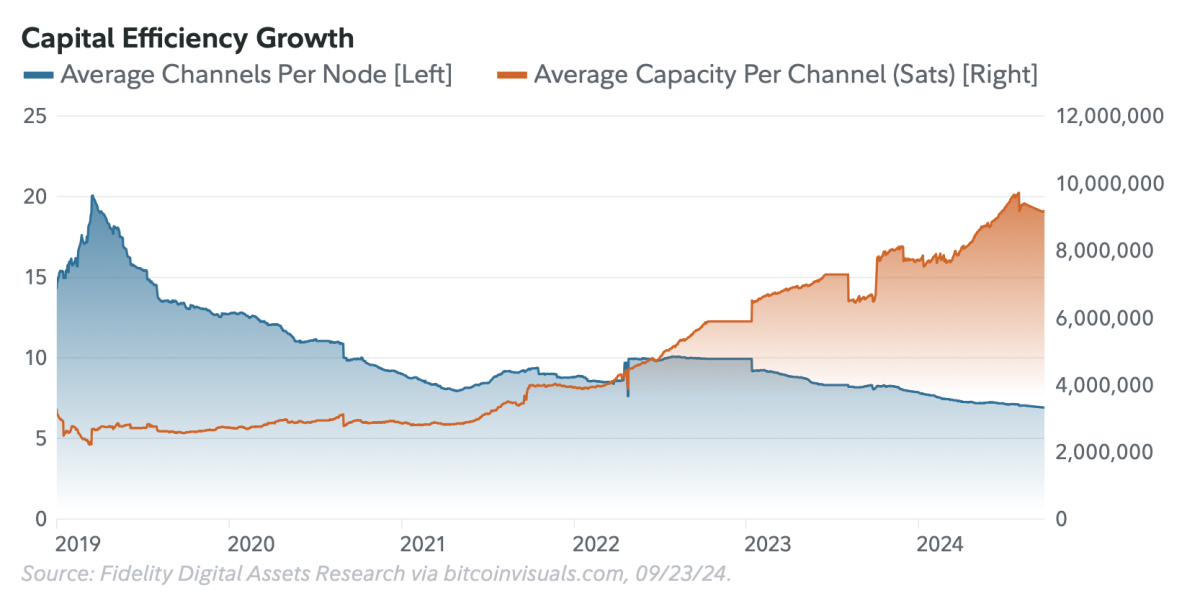
In a report released this Wednesday, Fidelity Digital Assets in collaboration with Lightning payment provider Voltage released a report on the state of the Lightning Network.

The report details the many ways in which the Lightning Network has grown since its launch in 2018.

It also illustrates how more businesses have begun incorporating Lightning in 2024 than any year prior, that larger channels are forming on the network and that more Lightning nodes are coming online.

Source: The Lightning Network: Expanding Bitcoin Use Cases

Some key stats from the piece include the following:

  • Total Lightning capacity denominated in U.S. dollars has increased by 2,767% since 2020
  • Its bitcoin-denominated capacity has grown by 384% in the same period
  • Currently, almost all payments over Lightning below 1,000,000 sats processed in less than 1.1 seconds

While these stats made me optimistic, it was other information in the report that really resonated with me and made me rethink how I view Bitcoin and Lightning.

Below were top three takeaways from the report:

  • Lightning payments are gaining traction on Nostr (the world’s largest bitcoin circular economy), as Nostr users have sent over 3.6 million individual zaps in the last six months
  • Projects like ARK, another Bitcoin Layer 2 protocol, illustrate that Lightning has use cases beyond just peer-to-peer channels (ARK allows users to share virtual UTXOs (vUTXOs) with a larger group instead of on a one-to-one basis) can can be built upon in ways many didn’t initially anticipate
  • The “HODL” mentality is one the things still slowing Lightning adoption; in other words, if Bitcoin enthusiasts don’t spend their bitcoin, Lightning growth may stagnate, which could hurt Bitcoin’s value proposition

So, as we’re here at the beginning of 2025, a year that many think will be big for Lightning, I can’t help but be optimistic to see what sort of traction Lightning gains in the next 10 months.

It’s high time bitcoin is used more as a medium of exchange — the way Satoshi intended for it to be.


Conference Bitcoin Afrique: A Bitcoin-Only Revolution in French-Speaking Africa

In April 2025, Bitcoiners from across the world will converge in Douala, Cameroon, for the Conference Bitcoin Afrique (CBA), a groundbreaking event dedicated to Bitcoin adoption in French-speaking African countries.

This is not just another crypto or Bitcoin event — it will be a focused, high-impact gathering that aims to educate, empower, and connect the French-speaking Bitcoin community like never before.

With over 400 in-person attendees expected and a digital reach exceeding 50,000 people via social media platforms such as Facebook, X, Youtube, and TikTok, this conference represents a crucial milestone in Bitcoin adoption across French-speaking Africa.

But why is this event French-only and Bitcoin-only? And why is hosting it in Douala, Cameroon, so significant? Let’s explore.

The Franc CFA: A Legacy of Economic Dependence

To understand why Bitcoin adoption is gaining traction in French-speaking Africa, one must first understand the controversial Franc CFA — a colonial-era currency used by 14 African nations and controlled by the French Treasury.

For decades, this system has hindered economic sovereignty, imposed high inflation rates, and restricted monetary policy independence for millions of people.

Unlike Africans living in English-speaking Africa countries, who often enjoy greater monetary autonomy, Africans in French-speaking African nations remain tethered to a financial system that prioritizes stability for France over the economic growth of Africa.

This is where Bitcoin comes in.

Bitcoin offers an alternative: an open, decentralized, and inflation- and censorship-resistant financial system. It empowers individuals to take control of their wealth without having to rely on centralized institutions or foreign influence.

Conference Bitcoin Afrique is dedicated to showcasing how Bitcoin can help break these economic chains.

Why a French-only Bitcoin Conference?

Despite the growing Bitcoin adoption worldwide, French-speaking Africa remains underserved when it comes to Bitcoin conferences.

Most major Bitcoin conferences, educational resources, and businesses are heavily English-centric, leaving millions of French-speaking Africans behind in the global Bitcoin movement.

By making Conference Bitcoin Afrique a French-only conference, we are dismantling the language barrier that has long prevented access to Bitcoin education and networking opportunities. This is not just a regional event—it is a movement to establish French-speaking Africa as a major force in the global Bitcoin economy.

For international businesses and Bitcoin advocates, this is a unique opportunity to engage with an untapped market, create localized solutions, and build relationships with grassroots Bitcoiners driving adoption on the ground.

Why Bitcoin-Only?

Unlike many crypto conferences that mix Bitcoin with thousands of altcoins and blockchain projects, Conference Bitcoin Afrique is Bitcoin-only. Here’s why:

  • Bitcoin is the only truly decentralized and censorship-resistant digital asset.
  • It has the strongest network security and adoption globally.
  • It is the best tool for financial sovereignty in Africa.
  • It aligns with long-term wealth preservation, not speculation.

The “crypto” narrative in Africa has often been tainted by scams, Ponzi schemes, and unreliable tokens. Many people have lost money chasing hype, and we believe it’s time to refocus on Bitcoin’s core mission: financial freedom and economic empowerment.

At Conference Bitcoin Afrique, attendees won’t be bombarded with questionable “investment opportunities” or flashy tech gimmicks. Instead, they will gain real insights, practical tools, and networking opportunities that support the real-world adoption of Bitcoin.

It’s worth noting that this is not the first Bitcoin-only conference in the region. In fact, we draw inspiration from several pioneering events:

  • Dakar Bitcoin Days in Senegal was the very first Bitcoin conference held in French on the continent, setting a precedent for accessible, localized Bitcoin education.
  • Bitcoin Mastermind in Benin, organized by Loic Kassamotto and Alphons Mehoume, and the efforts of Nourou with two editions of Dakar Bitcoin Days have all laid the groundwork for what we aim to build.
  • The African Bitcoin Conference also deserves to be mentioned for its significant contributions as an inspiration and benchmark.

With CBA, we are attempting to create a larger Bitcoin educational platform for the region so that we can make our collective voice louder.

Our long-term vision is to bring Conference Bitcoin Afrique to different French-speaking countries in subsequent editions, further expanding the reach and impact of Bitcoin education across Africa.

Why Douala, Cameroon?

Douala is the economic capital of Cameroon, a major trade hub, and one of the most Bitcoin-active cities in the region.

Hosting Conference Bitcoin Afrique in Akwa, the city’s central business district, is strategic for several reasons:

  • Accessibility: Douala is well-connected to other African cities and international locations.
  • Growing Bitcoin Community: The city has a thriving Bitcoin scene with active P2P trading, businesses accepting Bitcoin, and grassroots education initiatives.
  • Strategic Location: Cameroon is at the heart of French-speaking Africa, making it an ideal meeting point for attendees from West and Central Africa.

For global Bitcoin advocates, this is a unique chance to experience firsthand how Bitcoin is transforming everyday life in French-speaking Africa.

Get Involved

Bitcoiners, businesses, and global stakeholders can support this initiative by purchasing tickets or sponsoring the event.

Information about both is available via the conference’s website.

Conclusion: A Call to Action

Conference Bitcoin Afrique is more than just an event — it is a movement. And it aims to liberate French-speaking Africa from financial colonialism, to educate communities on the power of Bitcoin, and to connect international Bitcoiners with a rapidly growing market.

The time to act is now. Join us in Douala from April 25th to 27th, 2025, and be part of history.

This is a guest post by Nzonda Fotsing. Opinions expressed are entirely their own and do not necessarily reflect those of BTC Inc or Bitcoin Magazine.


FPPS Is Not A Free Lunch For Bitcoin Miners

Bitcoin mining is a tough business. When one considers deploying economic resources to mine traditional commodities such as gold, copper or oil, prospecting for those resources in the field is always done beforehand, to ensure that any capital invested in a mining project will not be in vain. But due to the very nature of Bitcoin’s security protocol, miners are not able to prospect for anything, since finding a block is a purely statistical and random event. Since there are only 144 blocks to be found per day, there is no way to ensure that a miner's work will be rewarded in a timely fashion without significant variability, unless the miner has a considerable amount of hash rate. A miner needs roughly 1.2% of the total hashrate (approximately 10 Exahashes per second at the time of writing) to guarantee consistent payouts and significantly diminish its revenue variance. The CAPEX required to achieve such an amount of hashrate is in order of hundreds of millions of dollars. Unless a miner is a gigantic enterprise that has an enormous flock of ASICS, he will have a problem in his hands.

Pool mining was created to address and solve this issue. Let’s take a single miner, with a small but considerable mining operation. Out of the 52560 yearly blocks, he’s expected to find one, since he has 1/52560th of all the hashrate of the network. In other words, he’s expected to find one block every 12 months. But his electricity bill comes due every 4 weeks, and if he was to wait for a whole year paying bills before getting some revenue through the door, he’d go bankrupt. Given this discrepancy between its ongoing costs and its revenues, an idea comes to his mind. He sets out to find 499 other people with a similar sized operation, and they strike a deal. Instead of everyone mining on their own, the miner proposes to the others that they all mine collectively as if they are part of the same entity, splitting the mining rewards according to each miner’s work every time someone finds a block. If every miner has 1/52560th of all the hashrate of the network, the 500 miners collectively are expected to find a block approximately two times per week. With a pool mining approach, every miner guarantees that all the effort and hard work they put in will be rewarded much more frequently. This way everyone gets to pay their bills every month, and by the end of the year, they have all effectively managed to avoid bankruptcy. Nevertheless, there are still sources of variance within those same payouts.

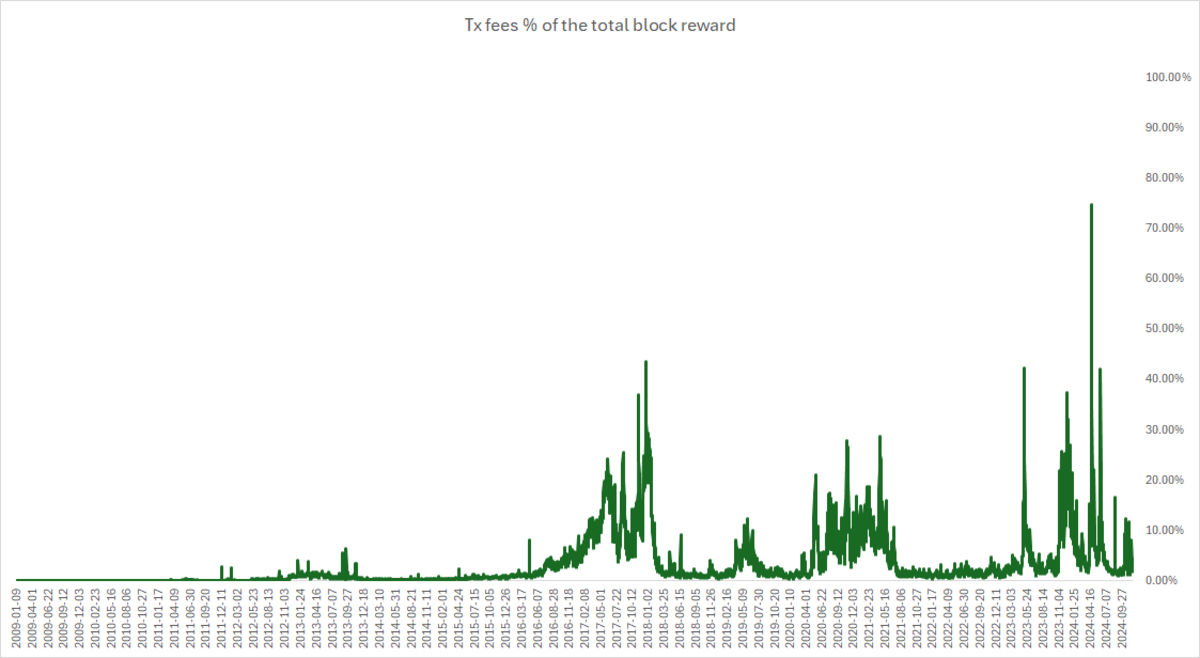
Pool mining makes sure miners get paid much more frequently compared to solo mining. However, it doesn't guarantee predictable payouts based on the hashing power that each miner has. This problem is commonly known as the pool’s luck risk. Let´s go back to the previous example. 500 miners with 1/52560th of the total hashrate of the network each are expected to find 500 blocks in a year. Nevertheless, they may find 480. Or 497. Or 520. There is no assurance that the pool will mine exactly 500 blocks in a year. A Pool’s luck is calculated by dividing the number of blocks found by the number of blocks that was expected to be found based on the total hashrate of the pool. If a pool mines 480 blocks when they were expected to mine 500, the pool’s luck was 95%. Pool luck can cause significant fluctuations in earnings over short periods. However, luck tends to even out over time, and payouts will eventually align with the expected distribution based on the pool's hash rate. Two additional factors contribute to the overall variance in miners' payment rewards, with the first factor being more significant than the second. The first is transaction fees. These tend to vary considerably as witnessed in the last few years. Transactions fees from the blocks that were mined right after the last halving represented more than 50% of the total block reward for the first time in Bitcoin’s history. As of the writing date of this article, (block height 883208), there were several non-full blocks mined in the past week, since the mempool cleared for several occasions during these past days. Quite a jump in such a short amount of time. The second factor is related to the variance associated with the time between blocks found by the network. When a block is found right after another, there is less time for transactions to build up in the mempool, which leads to lower transaction fees in that block. Conversely, if a more extended period elapses between blocks, more transactions will be broadcast, driving up transaction fees in the process.

During the 2024 halving, for the first time in bitcoin’s history, daily transaction fees paid to miners were higher than the block subsidy.

Uncertainty is painful. Especially where there is substantial capital at risk. Thus, most miners find value in having more predictable, stable and less volatile payouts to recoup the significant amount of capital deployed. This is where a Full Pay Per Share payout scheme paid by pools comes into play. FPPS works as a traditional insurance product. A pure risk transfer. Regardless of how many blocks the miners of the pool collectively find and what the transaction fees paid on them are, miners get paid by the pool based on the expected value of their hashing power. The pool assumes all that risk. The predictability that FPPS provides to miners is unrivaled by any other method. Hence, no one should be surprised to learn that FPPS is pretty much the standard nowadays when it comes to pool payouts, although not without a significant cost.

FPPS is not a free lunch. To withstand any bad luck period and all the risks associated with a FPPS payout scheme, pools need to have big fat pockets. These high capital requirements cost money. And pools are not charitable organizations. These high costs end up being paid by miners through higher pool fees. Like previously mentioned, miners need to keep in mind the fact that an FPPS payout scheme works as an insurance policy. And insurance policies rely on counterparties. And sometimes, counterparties fail to honor their commitments when they are most needed, as witnessed back in the 2008 Global Financial Crisis. The miner must trust that the pool will fulfill their insurance contract obligations. Sure, if the pool is very big in size, that risk is very small indeed. Pools can also develop ways to offload this risk from their operations. But isn’t Bitcoin all about minimizing trust, counter-party risk and eliminating it if possible? Looks like the Bitcoin ethos hasn't arrived yet at the pool mining side of the protocol.

Furthermore, any miner that receives FPPS rewards for their work must necessarily forfeit any revenue related to transaction fee spikes. The FPPS payout formula determines miner rewards by analyzing transaction fees from the previous n blocks and calculating an “expected value” for transaction fees. The pool then uses this calculation to decide how much to pay miners for the transaction fee portion of their shares. As a result, when transaction fees surge, the payout is made according to what happened in the past, where there is no transaction fees spike whatsoever. No need to be a PhD in mathematics to understand that all those rewards end up in the pool’s pockets rather than the miners’ in this scenario. Moreover, even if there was a recent spike in transactions, pools cannot factor this into payout calculations. The probability of such a spike not being an outlier is almost negligible. In other words, pools have no guarantee that the fee spikes will be consistent and frequent in the future. Therefore, they cannot include it in miner payouts without risking bankruptcy.

The unsustainability of the FPPS payout scheme

Having a closer look at how the FPPS payout scheme is built, we can easily see that it is like the modern pension systems of many governments, unsustainable by design. FPPS as it stands today, will collapse under its own weight soon. As time goes by, transaction fees will represent a bigger percentage of the total payout to miners. This dynamic, alongside their inherent variability, will lead to a significant increase of the total payout variance, thus increasing the insurance costs of FPPS pools to infinity. In other words, as the Coinbase reward keeps halving, the variance of the rewards in the block will increase significantly. If the variance increases, so does the associated risk of providing this insurance product for miners. Thus, premiums for the insured will have to increase as well. This means that FFPS pools will be taking additional risk when compromising themselves to a fixed payment to miners. With more risks comes higher capital costs. The extent to which pool fees will have to rise for pools to continue providing a FPPS insurance product remains to be seen. Only insurance actuaries can determine the precise amount. One thing we already know for sure. It won’t be cheap, because it already isn’t.

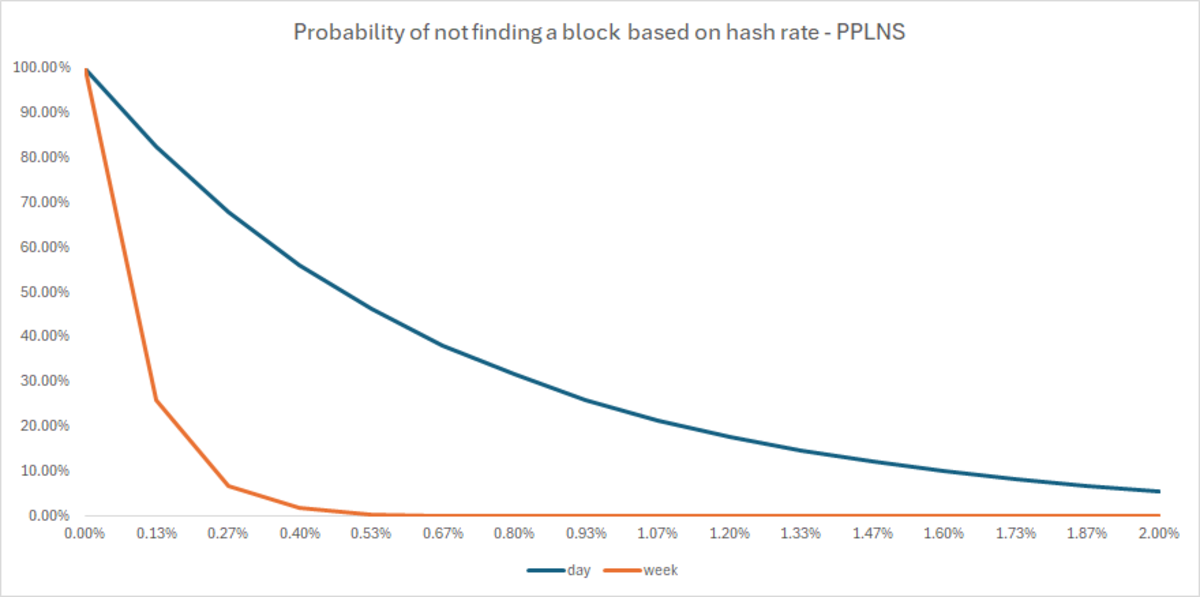
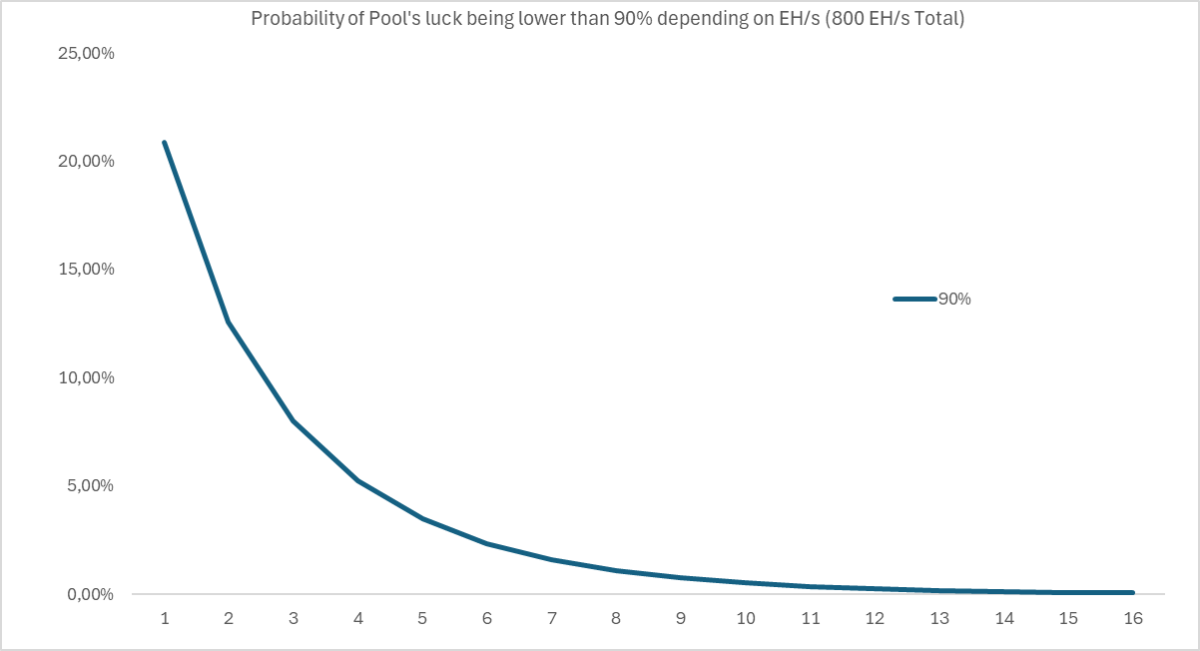
A much higher pool fee for stable predictable payouts offered by FPPS will make a PPLNS method reward method much more attractive for any miners that are looking to maximize their profitability, as the previously described dynamic of the changing composition of blocks is played out. Under this scheme, miners are paid once a block is found by the pool. When a block is found, the pool assesses how many valid shares each miner contributed during a period comprised of the last N blocks found by the pool and distributes payouts accordingly. This time window is commonly referred to as the PPLNS window. The biggest setback with this payment method is of course the risk associated with the pool’s luck being under 100% and the risk that there might be periods when the pool doesn’t find any block and as a result, miners don’t get paid. However, a pool with only 1% of the hash rate has only a 0.0042% chance of not finding a block within a week, while the odds of the pool’s luck being lower than 90% in a year are approximately 1.09%.

If a PPLNS pool has more than 1% of the total hash rate, the risk of not finding a block during a significant period of time is negligible.
The odds that the pool’s luck of a PPLNS pool with more than 1% of the hash rate falling under 90% are less than 1%. (Calculations made assuming the number of blocks found by the pool follows a Poisson distribution where λ = expected number of blocks found by the pool within a year.)

Will there be a market soon for FPPS pool services at a high enough price that compensates the pool for all the variance associated with the total block rewards? No one can know for sure. One thing we know. Pool fees will have to be enormous. The revenue that miners will have to forfeit will just be too big to be worth it to get rid of the risk associated with not getting paid consistently in a timely manner. And as other more mature players enter the bitcoin mining industry, such as energy companies, one should expect other risk management tools to be readily available in the market for miners to hedge all types of risks. New innovative pool payment schemes will probably surface as these instruments become more available to everyone.

Miners' revenue and profitability will be significantly impacted by the dynamics described in this article. Exploring alternative pool payment schemes and risk hedging strategies will be required for any miner that looks to maximize the profitability of their operation. The FPPS payout method might still be helpful for miners as of today. But as was previously explained, FPPS will soon be buried in bitcoin’s history.

This is a guest post by Francisco Quadrio Monteiro. Opinions expressed are entirely their own and do not necessarily reflect those of BTC Inc or Bitcoin Magazine.


The Next Decade, Part 4: Actual Predictions

Think back through Bitcoin’s history. I guarantee you a handful of events just popped into your mind first, like landmarks. If you kept thinking your mind probably started filling in from there with those landmark events as anchors.

Don’t take these as hard predictions, ignore the coating of hyperbole I can’t stop myself from adding everywhere, and note these don’t come with dates. I’m going to run through a list of “watershed moments” or macro-scale shifts in things that I think are practically guaranteed to happen or begin in the next decade.

— A Visit To The US Supreme Court —

Bitcoin creates an inherent contradiction within the current regulatory and legal framework, at least in the US and everywhere the US effectively dictates things, relating to how Bitcoin itself inherently works and two major themes in regulations and law.

  • KYC/AML Laws: These exist to ensure that financial institutions know the individuals they are dealing with for the purposes of preventing criminal operations, money laundering, or terrorist financing occurs through the use of their services. This requires incredibly invasive information collection, tracking, and communication of said information between different institutions. It requires throwing privacy out the window. Or does it?
  • Financial Privacy Laws: The reason things like KYC/AML exist in a country like the United States with the 4th Amendment to our Constitution is because of things like the Right to Financial Privacy Act. There are laws that restrict the situations and conditions under which the government can obtain financial records on its citizens. These laws were implemented after a Supreme Court case challenging KYC/AML law (ironically called the Bank Secrecy Act) held that financial records are the property of the institution and not customer.

See the contradiction? All of this is based on the notion that the record of financial activity is privately held in privileged silos not visible to the general public. That the government access doesn’t equate to the public’s access. That is not how Bitcoin works. Everything is right there on the blockchain for everyone to see. So while financial institutions are required to enforce KYC/AML laws and identify their customers, are they also not required to protect the privacy of their customers financial activity short a legal order to divulge it?

We’re at the point where privacy tools are actually starting to make real developments in the Bitcoin ecosystem, and we’re already starting to see behavior indicating a trend of this being marked as “bad behavior” by Bitcoin exchanges that leads to account scrutiny(and possible closure and/or seizure down the line) in response to use of privacy tools. Now, I don’t see anything in the near future in the United States smashing down all KYC/AML laws in the land, but I do see an incredibly strong argument to make against this type of reaction by exchanges and institutions to their customers using privacy tools.

The argument is this simple: they have a right to protect their privacy from the point of view of the general public at large. This system doesn’t keep all the records private by default, only revealing selectively to authority. Everything is in the open and publicly verified, by architectural requirement. So if I have a Constitutional right to privacy in the old model, do I not have one in this new model?

Now again: this is in no way a strong enough basis to smash down all KYC/AML and requirements to identify customers. But I do think this is a strong enough basis to potentially cement by Supreme Court ruling that businesses are not allowed to censor or target customers simply on the basis of using privacy preserving tools in activities not related to those businesses. If things continue in the direction they seem to be going, I think this type of legal challenge to such practices is inevitable. How will it turn out if I am right? I guess we’ll find out if I am right.

— Inevitable Mining Landscape Evolution —

Mining is probably the easiest thing to point at besides the price to really demonstrate to a normal person how far Bitcoin has come in the last decade. Consumer desktops to data centers in a decade. That change will continue to happen at a rapid pace, and part of the next shift is already underway. Vertical integration. Things went from desktop CPUs, to GPUs, to special ASICs. But those ASICs were still something easily accessible to retail consumers, small group buyers, smaller professional operations. It was still easy to get efficient and current hardware at different scales (though different prices depending on your scale).

That is going to change, and the starting signs of it are already here. Mining is going to become less and less accessible profitably to the retail and smaller market (ignoring professional hosting arrangements) participants as companies start battening down the hatches. This market is still incredibly volatile, and miners all the way from producers to equipment operators have very large capital investments that can be very risky during market downswings. Things tend to get into a frenzy when the market swings up, and go very badly for unprepared people on the swing down. This time around things are going to get serious in terms of minimizing and managing risk.

Bitmain’s finances becoming public during their IPO attempt in Hong Kong showed how they took massive profits and turned right around and lost them continuing to take massive risks that just happened to work out in a bull market. It hit them very hard, and the HKEX looking at that general pattern due to overall market volatility playing out with all the manufacturers attempting IPOs to differing degrees denied all of them. The overall market these companies compete in was deemed too risky for listing a business that directly exposed on the HKEX. This cuts them off from the capital necessary to continue expansion as Bitcoin grows by orders of magnitude. That is very bad.

The response from Bitmain in terms of adapting (ignoring the recent “coup” attempt internally) has been to make moves to restructure their business to adapt to this harsh lesson. They have numerous farms they operate themselves in China to both self-operate mining equipment and host other peoples’. These types of operations have expanded internationally to Texas and Washington state in the US and Quebec in Canada. The strategic value in operating these farms is creating predictable power costs, and having the dual option of deploying hardware you produce to mine yourself or sell capacity to other miners. Now if you put this together…they’ve positioned themselves to 1) make and sell the metaphorical shovel, 2) dig with it themselves, 3) sell the shovel to someone else and also try to sell them a place to dig. That’s exactly what Bitmain is doing with a new service.

Jihan has also established new financial services and tools Bitmain is offering to help customers hedge some of their risk by taking it on themselves, as well as other more granular arrangements in Bitmain’s favor. It’s unclear whether this specific strategy will stick given drama resulting from the internal struggle between Micree Zhan and Jihan Wu, but it shows an acknowledgement of and a strategy to deal with the risk inherent with this level of market volatility. This is absolutely necessary to survive in the long term in this sector of the ecosystem.

This is the direction this is going, with massive momentum behind it. Actors playing different roles in the mining sector will slowly start to try to sprawl out and handle every layer of the stack they can internally: Production | Research & Design | Hosting | Operation | Electricity Sourcing | Financial Risk Hedging | Lobbying. As economies of scale continue applying pressure to actors in the mining sector and trimming them down to the leanest and most efficient, they will start attempting to internally integrate as much of the entire stack to be able to control and hedge the financial risks.

A second order effect will result from this economy of scale effect playing out Darwinianly amongst all of the miners. Governments will start to creep in at a foundational layer and begin realizing they have influence to exert. To really get across my thinking here, I want to go back in the past for a second and look at some of the mining dynamics in China to my understanding from both “official” reporting and personal sources of mine. Mining exploded in China because of two factors: 1) there is surplus power in many places, 2) the finances of local governments being pretty rekt and lots of local governments being totally fine with mining because they can shave something off the top and see revenue. This dynamic might even be why we haven’t seen the Communist Party crack down on mining despite all the statements and hints to that end except in criminal cases such as power theft.

That dynamic is already playing out everywhere that mining operations are growing to scale. Step one: appease the local government. We’ve seen how things can get with the situation in Quebec with Hydro-Quebec attempting to block and auction power after seeing a huge increase in demand for electricity to mine Bitcoin. Numerous projects across the United States have been established in partnership or cooperation with the local government, in Texas, Washington, Georgia, etc. This is just how it works, you put boots on the ground and that most immediately local government at the very least is sinking their hooks in. Then the one above that can sink in. Then the one above that. The hierarchy of parasites.

We need to be very, VERY conscious of this dynamic. Unless you find Harry Potter’s wand and the magic spell that instantly whisks away every government in the whole world, they’re there and we have to deal with them. There’s only two real strategies to deal with this, and one isn’t really viable.

The non-viable strategy is attempt to take things completely off the grid and into the black market. That’s not happening. You are talking about hiding data centers, with the cumulative network energy consumption being on the scale of whole countries. Non option, and if you want to try and solve this with a POW change fork, good luck. You know where the door is.

The viable strategy is to simultaneously: 1) push at the most local levels for non-restrictive and non-draconian policies where these operations are located (and Bitcoin in general where you live) if you can while 2) pushing at the non-local levels in general for policies that leave sovereignty and power as localized as possible. If Bitcoiners and other interested groups do not stay vigilant and active in this area, then those initial local hooks will lead to State hooks which lead to Federal hooks from the national government of your country in the foundation of the mining sector: power availability. These hooks are undeniably already there in some places. If action at the social layer is not effective in dealing with this issue, then we fall down a very slippery slope:

  • Eventual slide to national level regulation and direct hands poking around in how mining operations are run.
  • If Bitcoin continues growing and expanding in value and market relevance exponentially, the situation works out to whichever nation has the cheapest energy reserves to burn through dominates mining.
  • This could easily devolve into a super power like dynamic in terms of mining distribution, which if a stable (or “stable enough”) equilibrium, could wind up leading to a base layer in a much more centralized and restricted access state not conducive to Bitcoin’s full potential.

This aspect of the Bitcoin network/system is the weakest in terms of defensibility from real world “meatspace” threats. Ultimately if the population of a nation empowers its government to do so, they can show up and seize your mining equipment. It would have to be an amazingly resource strapped government or a very unique geographic area for that to be impractical. The only way to deal with this is socially.

And coercion is not the only mechanism for interfering at this layer of Bitcoin. Distorting incentives is another means. Chain Anchor was a protocol proposal out of MIT to effectively bribe miners into initially preferentially, and then exclusively mining KYCed transactions. The end goal was orphan non-compliant blocks. (This out of all citations, READ YOURSELF when you are done with this). These issues of economic incentive distortions can ultimately be resolved only through economic incentive corrections.

This is the “shift” I am most confident on in this piece. I would not call it short-term “OMG we’re fucked!” urgent, but this is not an issue Bitcoiners can afford to be complacent about.

— Neo-Switzerland —

I spoke above of Binks, and the technology possible to “port” subsets of Bitcoin’s properties to them, and the incentives to do so. It’s a jurisdictional arbitrage play with massive potential profits. But there is one interesting potential twist to how that could play out given it is the 21st century and all: cyberspace could itself arguably constitute a jurisdiction. Does anyone remember Darknet Markets? So there are two ways “Neo-Switzerland” could play out: an actual physical jurisdiction legalizing KYC-less or KYC-lite financial businesses and safe havening such operations, or an “extra-jurisdictional” (quotation marks because servers get hosted somewhere) dark net business.

Meatspace Neo-Switzerland

Let’s go through the possibility of a real world nation-state deciding to become a haven jurisdiction for KYC-less or KYC-lite binks. Well to start, Bitcoin is a borderless global currency/settlement network that anyone with internet access can interact with. So the potential customer base that can deposit and withdraw Bitcoin at one of these binks is anyone in the world with an internet connection that can get their hands on Bitcoin. That’s the potential capital inflow that could be attracted in the most insanely optimistic scenario. That’s what you can collect taxes on. Secondly, given a host jurisdiction, these binks can be legally incorporated and accountable entities. Even with no KYC cryptography offers a basis of both assertions of fraud, and refutations of these assertions, at least in terms of a foundation or initial filter from which to start legal disputes. These binks can offer anonymous accounts denominated in BTC, anonymous untraceable cybercash denominated in BTC, loans, escrow services, oracle services for complex smart contracts enforced by the Bink. All the financial services of the legacy world become accessible with a smartphone and either no KYC or so little it feels like 2013 again, and then some with a cherry on top.

This is a giant pile of potential profit for a jurisdiction to seize. And being a jurisdiction, an actual nation-state with a legal system, there is the potential to create enough trust to actually make this workable for international customers. Okay, so from a customers point of view how do you handle something going wrong between you and your bink? If you’re a citizen of that nation simple: you take legal recourse. If you aren’t a citizen? Well…taking legal action across international jurisdictions can be complicated to say the least. And expensive. But if we’re at the point where this bink is operating then we assume the government of this nation wants this to work and attract business right? So the government can account for this asymmetry between citizens bink customers and non-citizens bink customers and craft legislation easing the complexity of non-citizens dealing with disputes between them and their bink. And more importantly, the government can actually enforce this legislation evenly with regards to citizens versus non-citizens.

The other end of the stick is how do the other nations of the world react? The US in particular likes to tell the world how to run their affairs. Especially their financial affairs. How far can you really push things before the US drone-strikes your country into the ground? No one will know unless someone tries this.

That said, I think the type of jurisdiction where this could practically happen would be one of a very few unique profiles. Potentially somewhere such as North Korea, Iran, Venezuela, somewhere that is being heavily sanctioned and shut out from the global financial situation. Desperation is a powerful motivator. Or maybe a Spanish or Italian secession movement is successful, or France slow boils until we see a 21st century French Revolution. Big changes happen after big political upheaval. What if the King of Thailand decided to host KYC-less(or KYC-lite) binks? Thailand is already massively economically dependent on foreign tourism dollars. Why not foreign Bitcoin deposits? Tourism has had many negative consequences for the country…Bitcoin binking wouldn’t unless you thought you would be invaded by China or the US.

This is not something I’m saying is a very likely thing to occur in such a relatively short time period as the next decade, but I’m saying it’s absolutely not crazy to think it might.

Cyberspace Neo-Switzerland

Alright, let’s look at the “darknet, no known jurisdiction, totally pseudonymous” scenario. Things are the exact same as the previous scenario as far as deposits and customers, they can process BTC withdrawals and deposits for anyone in the world. But a bink that operates extra-legally cannot legally incorporate in any jurisdiction, or establish any legally accountable entity. That is a major difference in terms of trade offs versus a bink being hosted by a complicit jurisdiction. This is a much more difficult place to attempt bootstrapping a network effect as a bink, in terms of acceptance of your cybercash and deposits rather than direct BTC settlement. A bink’s network effect is rooted entirely on trust in the operator(s) of the bink. That is much easier to build as a legally incorporated and accountable entity of a known jurisdiction. The landscape your relationship with that bink takes place in is established crystal clearly. That is the opposite of how a darknet bink would work.

There would be no legal accountability for a darknet bink, no government to go to, no legal processes to take, nothing. You get the guarantees you can enforce purely with cryptography, and everything else is enforced through blind trust with no recourse. That’s it. This presents a major bootstrapping problem for this variety of bink. How do you get customers to trust you with their deposits when they have no recourse to take if you defraud them? This quandary in my opinion guarantees that this type of bink would never be able to grow to the size of one that had a legal identity in a safe haven jurisdiction.

A darknet bink would likely never be something used by mainstream users, they would be businesses patronized solely by users in very constrained circumstances. People engaged in risky illegal activity. Scammers. People who have been censored and completely walled out of the legacy financial system. I just don’t see normal people being willing to take the risk of depositing BTC with a bink against which they have no legal recourse, and which is associated only with pseudonyms. There is the potential of creating stronger guarantees than possible now through cryptography, but that starts getting into a strange area. Like I said above when talking about the possible technical developments in the next decade, there is potential for constructs that totally blur the line between service and protocol. If things work out well enough, maybe a darknet bink could make up for the difficulties in establishing trust by building stronger cryptographic safeguards.

I think there is a very good chance things like this start operating in the next decade (especially a simple trust based darknet bink), the only question is how rampant will the exit scams be?

— Birth Of A New Market —

Bitcoin is evolving into money, that’s what we’re all witnessing and participating in. Speculation, to value transmission, to unit of account. A core and absolutely required dynamic for this evolution to be completed is a massive and liquid arbitrage between Bitcoin, fiat, and goods & services. This arbitrage is what will allow businesses to actually accept and use Bitcoin. Once Bitcoin is large and relatively stable enough, a business can accept it and pay suppliers without the kind of volatility risk that exists currently. The closer Bitcoin’s stability gets to a respective fiat currency, the safer it is to accept and use Bitcoin directly rather than immediately sell for fiat. Arbitrage traders will trade these gaps, businesses will probably arbitrage these pairs themselves! Is it a better return for you to accept Bitcoin or fiat for something? Incentivize with discounts. Is it a better return for you to pay your supplier in Bitcoin or fiat? That’s what you’ll make your decision on. This dynamic is what will truly launch Bitcoin into the realm of money.

Now, the world is shifting rather rapidly in terms of geopolitical balance. The US has spent the last 20 years playing Empire in the wake of 9/11, destroying numerous countries, pressuring the world to isolate others. We are clearly starting to see the reaction to this in the form of other nations beginning to develop alternative settlement systems and moving to lessen dependence on the USD. China and Russia have begun building their own SWIFT alternatives to settle payments. They’re also even trading oil against non-USD currencies. Venezuela is even trying to foster an oil trade in its own centralized “cryptocurrency” the Petro. The world is sick of American over-reach, and they are starting to take action to create platforms and systems not subject to American control and censorship.

This trend will undeniably continue, and inevitably begin to envelop Bitcoin itself. There is no reason why the arbitrage dynamic between Bitcoin <> fiat <> good & services has to start in the retail market. In fact, I think it very likely won’t. Within the next decade I am very confident that a coalition of nations in alignment against the United States will begin trading and settling oil against Bitcoin. If Bitcoin’s market capitalization, liquidity, and price continue growing at the rates they have historically then it is inevitable. The protocol and network can handle it, the products and services to hedge against the risk of volatility are becoming more numerous every year, and the overall liquidity would offer more utility than individual non-USD fiat currencies and nation-state funny “crypto” money.

An event like this would bring massive capital influxes and price movements like you could not comprehend, and I think the chances of this not happening some time in the next decade are extremely low. Buckle up.

In Conclusion

This next decade is going to bring change and evolution on such a massive scale it will melt your faces off. I really don’t think many people in this ecosystem really grasp that. Obviously the people building things, the company CEOs, the players actually involved in these shifts and changes know. It’s also definitely fair to say that the astute and balanced observers know as well. But most people who hold Bitcoin, or casually participate or spectate in this space…I don’t think they have any idea.

The last decade was the shift from cypherpunk pipe dream to playing in the minor leagues. This next decade is going to be the shift to the major leagues. Do we all fuck up? Do we knock it out of the park? Does someone get hit in the stands if we hit a homer?

Who knows. I think observant people are capable of seeing inevitable outcomes from large trends, of seeing the large trends themselves and projecting different ways they can go.

Things are serious now, and that requires acting and thinking seriously.


I Still Don’t Like Tether (USDT) On Bitcoin And Lightning

Follow Frank on X.

The news of USDT (Tether) coming to Bitcoin and Lightning via Taproot Assets has been met with various reactions.

Some believe it’s good for Bitcoin (most, actually, based on a small survey I conducted on X; yes, I know the sample size isn’t large enough for the results to be significant. I’M SHARING IT ANYWAY), while others aren’t so enthused about it.

“Others” includes me — I’m not so enthused about it.

That said, I’ve tried to be open-minded.

I even recently profiled Jesse Shrader, the co-founder and CEO of Amboss, a company that provides intelligent payment infrastructure for payments made over Lightning, who’s a proponent of USDT on Bitcoin and Lightning, in efforts to see what I might be missing about the benefits of being able to transact with digital U.S. dollars over Lightning.

In my interview with Shrader, he made the following points:

  • The proliferation of USDT has proven that there’s a demand for U.S. dollars globally
  • USDT is a massive payment mechanism; it processed over $10 trillion in payments in 2024, more than MasterCard, and some percentage of those payments will now be made over Lightning
  • USDT will bring more liquidity to the Lightning Network, which will help the network grow and handle bigger payments

From a business perspective, it’s hard to argue that the above aren’t good reasons to bring USDT to Lightning. And, as someone who believes that people should be free to use whatever money they want, I can't argue with them when looking at them through a practical lens.

However, I do believe that bringing USDT to Bitcoin and Lightning comes at a price.

One dimension of that price is technical, while the other is philosophical.

On the technical level, running USDT over Bitcoin and Lightning potentially puts Bitcoin’s security at risk.

If we see another Bitcoin hard fork comparable to the one we saw during the Blocksize War, larger economic nodes on the Bitcoin network, like the one operated by Coinbase, which manages much of the bitcoin that backs the U.S. spot bitcoin ETFs, may opt to support the “Tether fork” of the network, which could also include other changes to the network that could jeopardize Bitcoin’s security in the long run.

In other words, if the likes of Coinbase, Tether and some other major players in the Bitcoin space support and push for the “Tether fork,” other major economic nodes will likely follow suit.

What is more, everyone using USDT on Bitcoin and Lightning would also likely support that side of the fork, because the USDT that remains on the chain of the non-”Tether fork” will likely be nullified.

Lyn Alden wrote about this in her essay “Proof-Of-Stake And Stablecoins: A Blockchain Centralization Dilemma.”

In the piece she stated “custodians can nullify the value of all stablecoins on whichever side of the fork they don’t view as the correct one.”

Granted, Alden was referring to smart contract blockchains like Ethereum and Solana that rely heavily on DeFi, which stablecoins are a major component of, when she wrote this, but the same would apply to Bitcoin. (Alden was correct in this claim, as we saw when Ethereum shifted from a Proof-of-Work to Proof-of-Stake consensus mechanism during 2022’s “The Merge.”

Post-Merge, stablecoins issuers like Circle and Tether only continued to back the tokenized U.S. dollars on Ethereum, and not EthereumPoW (ETHW), the older chain that continued running the Proof-of-Work consensus algorithm.)

The same type of scenario could play out with Bitcoin in the event of a chain split, giving Tether an inordinate amount of power over Bitcoin.

My other reason for not liking USDT on Bitcoin is a philosophical one.

Bitcoin, which was released into the world in the wake of the Great Financial Crisis of 2007-2009, was created as an alternative to the U.S. dollar.

At the time, the dollar was being printed en masse (i.e., devalued) to bail out the same banks that caused the crisis.

Bitcoin, money that can’t be printed at the whim of a government or central bank, was created to compete with the U.S. dollar, not to help buoy it.

Bringing USDT, a mechanism the U.S. government uses to prop up U.S. dollar hegemony around the world, to Bitcoin feels morally wrong to me — and I’m not here for it.

So, on a practical level, I get why some are in favor of USDT coming to Bitcoin and Lightning. I just think that many are missing the bigger picture in that Bitcoin has potentially both been put in a vulnerable position and has had part of its value proposition overshadowed (albeit maybe just temporarily) as a result.

This article is a Take. Opinions expressed are entirely the author's and do not necessarily reflect those of BTC Inc or Bitcoin Magazine.


The Next Decade, Part 3: The Road Blocks(And Roads Around?)

Bitcoin Banks (or Binks). It’s happening. Guaranteed. Done deal. In the bag. It’s just a question of when? Germany cleared banks to custody and handle Bitcoin and Bitcoin accounts for customer starting 2020. Who will be the first?

This is one thing that people will spaz out about, and I get why, but ultimately I think it’s childishly naive to think this wouldn’t happen. First off, banks don’t exist just to hold your money for you and process payments. They make loans. There is a reason they do this, it’s a useful thing in an economy and society, it provides a return to the liquidity providers (with risk) and allows entrepreneurs to engage in endeavors they otherwise would not be able to finance. This alone guarantees they will continue to exist. Loans are based on trust, they require coordinators and people to manage and track them. They require central points: banks.

That said, I guarantee they will thrive on just custodying Bitcoin and processing payments on their own private second layers. People like having someone to call for customer support, they like having recourse when things go wrong, they like having specialists take care of things they are not specialized in. This is why people have a Google or Facebook account, and don’t run their own SMTP server or decentralized social media node. Now, I absolutely think things are going to shift back in that direction and that we’re already seeing the beginnings of that, but that trend is going to be a generational thing. It’s not going to happen overnight, and possibly not even within our lifetime. Or maybe things just trend that direction and falter before actually getting all the way to the extreme. Who knows. But I do know what the world is like today, and I do know the reasons it is like that today. So this will happen, count on it.

Fear not though, all is not lost. Centralized but private electronic cash has been possible since David Chaum came up with the original “Ecash” design in the 1980s. Extending these designs to encompass more complicated “smart contract” analogs with a centralized enforcement probably isn’t impossible, or even relatively hard. It is also perfectly possible to offer accounts denominated in Bitcoin without KYC/AML intrusion or doxxing. The impediments to these things have nothing to do with technological limitations, and everything to do with legal, regulatory, and social impediments. Those are things that can be shaped and directed. Yes, at the scales necessary for these types of impediments being removed the effort would be massive, but one cannot honestly say it is impossible.

There’s even an incentive to push people in that direction: regulatory arbitrage. Given that Bitcoin is global and entirely digital, any jurisdictions loosening regulations and laws regarding financial services could see revenue influxes from across the entire world by doing so.

The Political Arena

We are now full on in the spot light of the global political arena. Ignore that at your own peril.

Yes Bitcoin the technology is apolitical. Neutral. All technology is. But if you try and make the argument that Bitcoin’s effects on the world around it at scale are not political, and do not politically back everyone into a choice between individual liberty and full on totalitarianism, you are asleep. I’m American, this is going to be to some degree Amero-centric, so we’ll lay it out like this:

The right: The direction, DIRECTION, the Republican party leans. I am not saying it embodies it, just its a landmark in that direction.

The left: The direction the Democrat party leans. Again, same disclaimers as above.

Bitcoin’s mere existence shapes the environment to favor right leaning political structures. Structures that bias their actions towards those favoring individual liberty above all else. The bigger Bitcoin gets, the more it shapes the environment around it to favor that type of political structure. That is just the reality. The bigger Bitcoin gets, the more inevitable it is politicians begin framing it in these left/right terms. They will do it because that is what politicians do, and there is the kernel of truth in that framing to reinforce it plus the hyperbole, lies, and exaggerations that tag along for the ride.

This divide will likely concentrate mostly around two issues:

  • Wealth inequality: Bitcoin will be a hot-button topic in relation to this isssue. Bitcoin will definitely redistribute massive wealth, but not even close to evenly.
  • Environmentalism: the narrative that Bitcoin is hurting the environment will not be going away any time soon.

I could very well be wrong, but I see these dynamics playing out as almost foregone conclusions personally. Its just how Bitcoin falls into the current tug of war going on globally between ranges on the political spectrum. There is a giant tug of war going on everywhere between more localized small scale sovereignty, and less localized larger scale relinquishment of sovereignty to massive sovereign entities. Bitcoin naturally empowers and encourages the former, and is the natural enemy of the latter. As it grows larger, it will become more inter-connected with politics around the world, and this is likely a rough idea of how it will play out.

This will play out all over the world on the national level, the state level, probably even down to the city level after enough time. This will eventually get to the point where it moves beyond the point of international bodies debating regulation to respond to Bitcoin. It will start moving into the territory of alliances between nations based on their stance regarding Bitcoin. Once things really escalate to that level, it really is an open question how exactly that starts playing out.

You have two options:

  1. Work within whatever your local political process is to push things in the direction of localized smaller scale sovereignty.
  2. Opt out of the political process and its results where you can, and shut up and comply with its results where you can’t.

Choose wisely.

Big Boys Entering The Ring

Bigger markets = more liquidity = bigger players. This has already been occurring in a serious way for the past few years. The end of the last bull market saw the launch of the first cash settled Bitcoin futures. Since then we’ve seen trading start (and stop) for multiple Bitcoin products traded on legacy financial platforms. We now also have physically settled (delivering real BTC) futures on Bakkt, as well as options on those futures and their own cash settled futures product. German banks have been cleared to handle and offer cryptocurrency to their customers. The Swiss financial authorities and institutions have been friendly with the ecosystem for years.

These types of institutional entities and pools of liquidity entering the space is going to fundamentally alter the structure of this market to the foundation. With them is going to come the government regulations, government restrictions, and government requirements that come along with the legacy world. How much of the liquidity in this market that is attracted to the platforms these players build will dictate how much influence legacy government regulations and responses have in the overall ecosystem in the scope of the market and pricing mechanism. The more liquidity on these restricted platforms, the more indirect control governments will have over the pricing mechanism of Bitcoin. This indirect control over the pricing mechanism could potentially translate into another degree removed of indirect control over the outcome of any future consensus disputes. This is something to be wary of.

The observable trends suggest to me that the entrance into this market by these large pools of liquidity could very easily wind up crowding out the types of fly-by-night no-KYC bucket-shops currently making up a very sizable percentage of market platforms. This is going to make the market overall more restricted, more difficult to navigate while avoiding government bureaucracy and regulation, and potentially even difficult to maintain ideal consensus on the protocol itself if it follow through far enough to that extreme.

This very well could lead ultimately to a hard line partitioning the black market from the clear market in terms of Bitcoin trading platforms, maybe even Bitcoins themselves if things do not go our way regarding Bitcoin upgrades that ultimately compose to massive privacy improvements. Or if we become lax in defending our own rights to privacy if we reside in jurisdictions where those rights are recognized. This landscape is changing, and one way or another have to adapt.

Decentralizing The Infrastructure

Twitter censorship. Facebook censorship. Youtube censorship. Political bias. Political interference. Even DNS and VPS censorship. That is the world we are living in with regards to companies providing services on the internet or operating internet infrastructure. This isn’t a universal situation everywhere, nor is this type of censorship applied evenly to all things or activities, but it is undeniably a growing trend.

This needs to be attacked socially (though in a very thought out and cautious manner), but also technologically. The Fediverse is an experiment in creating a middle ground between a protocol and service through their federated environment where anyone can run a Mastodon instance (among many things) and connect them together through federations. Bluesky is a recent initiative started by Jack Dorsey at Twitter to engage in research to determine the viability of transforming Twitter from a private service into an open protocol, and if viable try to do so. We also have goTenna working on consumer products to actually decentralize physical infrastructure for data transmission. The bandwidth is limited, but it’s a start. There are also numerous DIY mesh networking projects.

That leads me into the efforts along this vein directly relating to Bitcoin itself. goTenna partnered with Samourai Wallet to produce txTenna. This allows someone to initially broadcast their Bitcoin transactions over a mesh network to obscure their identity, bouncing the transaction around the local goTenna network until it finds a node that can push it over the internet to the Bitcoin network. There is also the LochaMesh project in Venezuela, born out of the intermittent electricity and internet access due to the instability in the country. Their designs incorporate communication tools as well as Bitcoin and Lightning functionality, and they are according to my last understanding attempting to take their DIY project in a commercial direction to make available easily to consumers.

It would be remiss of me to go into this topic without talking about the Blockstream Satellite Feed. I wouldn’t call this full on “decentralization” of infrastructure, it is very much still centralized, but I would call it a substantial change that would be foolish to ignore. First, it is centralized. It is entirely dependent on centralized companies’ satellites; these companies are very much in a position to turn them off at any time. Second, it’s free and completely private. Being a one way broadcast from the satellite, all you have to do is set it up and point a dish in the sky and you’re receiving the Bitcoin blockchain. That doesn’t leave network fingerprints to identify you as a Bitcoin user, and as a benefit it’s free delivery of large amounts of data. So you depend on central entities, but gain a large degree of privacy.

These types of projects and different ways of designing and running infrastructure will continue thriving on the fringes of both Bitcoin and the internet in general over the next decade. There are also numerous ways to compose these things. Blockstream has partnered with txTenna to link their satellite feed now. I think that integration can go even further. Mesh and radio technology isn’t enough to scale the entire network globally using nothing else, but it can fill gaps or handle distribution for “sub-networks” concerned mostly with just propagating transactions and validating blocks. A node could receive blocks from the satellite feed and then propagate them over shorter range mesh networks that can handle higher throughput. This type of synergy might even translate to mining; with Compact Blocks miners can transmit only the block header and a small piece of data to construct the actual block from your mempool. If the latency trade off is practical, miners could attempt to use these types of mesh networks to obscure their physical location slightly during block propagation while receiving real-time block relay from an anonymous satellite feed.

I see a lot of potential for co-existence or integration between Lightning Network and mesh networking technology as well. Global Mesh Labs is working on the Lot49 Protocol to incentivize mesh network nodes by integrating Lightning Network to pay for relaying data. This is a very interesting direction things could go as far as evolving synergy between Bitcoin and mesh networking protocols, but its viability remains to be seen. Personally, I’m very optimistic but cautious in my expectations. Even without this type of tight integration of the two things though, mesh networking can be very useful for Bitcoin. I think it will be inevitable for localized Lightning sub-networks to start growing where everyone is peered over the mesh network, only interacting with local people over the mesh network, and receiving feeds of the blockchain for security. A few bridge nodes can route money in and out of these sub-networks as needed. At global scale those types of network structures just make sense to me and seem like a natural pattern things will fall into.

This stuff isn’t going mainstream in the next decade, but expect rapid progress and development as the die-hards and the crazies rapidly iterate on the fringes.

This is just Part 3 of 4, read the last part tomorrow. 


Amboss CEO Talks Growth Of The Bitcoin Lightning Network, Tether (USDT) On Lightning

Founder: Jesse Shrader and Anthony Potdevin

Date Founded: March 2021

Location of Headquarters: Nashville, TN

Number of Employees: 10

Website: https://amboss.tech/

Public or Private? Private

Jesse Shrader thinks that this will be an important year for the Lightning Network.

With Bitcoin’s price on the rise and Tether (USDT) coming to Lightning, Shrader posits that more and more businesses and institutions will begin to see Lightning for payments in the year ahead.

And his company, Amboss, is poised to help make this vision a reality.

“We want to extend Bitcoin as a payment system and use Lightning to do that,” Shrader told Bitcoin Magazine. “We want to make Lightning a high-efficiency, high-performance system.

Through a suite of tools and services Shrader and the team at Amboss have developed, they are prepared to onboard the next wave of institutional users to the world’s largest permissionless payment network — especially now that USDT runs on Lightning.

What Amboss Does

Amboss primarily provides intelligent payment infrastructure for digital payments using the Lightning Network.

“We deliver insights to people regarding what they should do to increase efficiency of payments on the network,” said Shrader.

To accomplish this, they offer a number of products and services.

One of the most notable of these is Amboss Space, which is a Lightning Network explorer that employs machine learning to help users retrieve information on or connect to any node on the network.

Beyond their analytics software, Amboss also provides its customers with tools and services to help improve liquidity conditions on Lightning.

One such service is Magma Marketplace, which lets users buy and sell liquidity on the Lightning Network. Using Magma, users can provide liquidity — without giving up custody of their bitcoin — for a yield.

Another is Hydro, an extension of Magma. The software enables users to automate their liquidity purchases to better ensure the success of payments.

(And Amboss also offers Reflex, a compliance suite for business customers with AML (Anti-Money Laundering) reporting obligations.)

Amboss’ analytics software and tools are built for high-volume transactions, which are becoming easier to make on Lightning.

“We measure businesses’ ability to make payments with simulations,” explained Shrader. “We'll help businesses see how much of the network can they actually reach when they attempt a payment.”

The State Of Lightning

Shrader is optimistic when it comes to the growth of Lightning. With each passing day, users are relying on the network to send more than just micropayments.

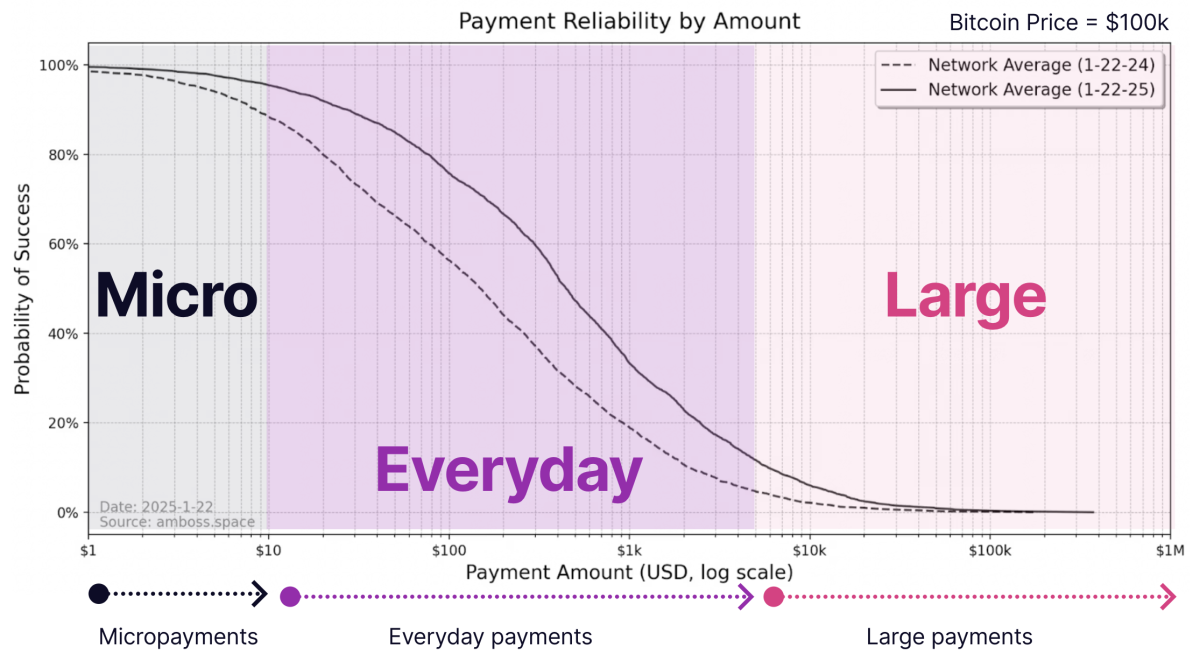
“We’ve been successfully processing everyday payments on Lightning, which I’m defining as between $10 and $4,000 payments,” said Shrader. “We’re working to enhance the network’s capabilities even further, with a focus on decentralization.”

A chart illustrating the reliability of Lightning payments, produced by Amboss with its data. | Image credit: Amboss

Payments larger than $4,000 are still difficult to process. Shrader explained that more capital is needed to help make processing larger payments a reality.

However, he also noted that the recent increase in bitcoin's price has helped larger payments to be processed more easily.

“What we saw recently is that the Bitcoin price has increased, which has increased the capability for settlement across all Lightning channels,” said Shrader. “Since the channels are bitcoin denominated, it's like we got bigger pipes.”

And while Shrader is optimistic about these bigger pipes allowing for more throughput, he also believes that Tether (USDT)’s coming to Lightning will attract even more liquidity to the network.

Tether (USDT) On Lightning

At the end of last month, Lightning Labs announced that it’s bringing USDT to Bitcoin and the Lightning Network via the Taproot Assets protocol.

This upgrade enables Bitcoin service providers to integrate and accept USDT more easily, which Shrader believes will be a boon for Lightning.

“One thing that's very clear is Tether has product market fit,” said Shrader.

“Last year, it served $10 trillion in payments, which exceeds Visa and MasterCard,” he added.

“It’s very clear that the world wants U.S. dollars.”

Shrader, a pragmatist, acknowledged the fact that many hardline Bitcoiners have issues with USDT running on Bitcoin and Lightning, and he sympathizes with them, as he appreciates that bitcoin’s sound money qualities.

At the same time, he thinks the benefits of having USDT on Lightning clearly outweigh the cons, as many still don’t understand what bitcoin is, nor are they willing to stomach its volatility.

“Many haven't yet taken the orange pill and come to understand the advantages of bitcoin,” he explained.

“I think bitcoin is an incredible tool, and I want to bring that to as many people as possible. With that said, there are a lot of problems with traditional payments, and Bitcoin has this very secure, auditable system, which is something that I want to bring to the world at scale,” he added.

“While bitcoin’s price action is great for me, a lot of people are afraid of volatility. If you have an asset with very low volatility like USDT, now on very secure, trustless rails, that's a huge win.”

The Problem That USDT On Lightning Solves

Shrader recounted how the first Bitcoin-related conference MicroStrategy hosted was actually called “Lightning for Corporations.” At the conference, companies were encouraged to start paying employees in bitcoin over Lightning — without fully realizing the troubles this would cause at the time.

“What employers realized was that all of the 1099s that needed to be submitted to employees was a hassle,” said Shrader. “And there was a whole bunch of regulatory overhead that they had to contend with, as well.”

Shrader pointed out that not only can paying employees in USDT over Lightning reduce accounting and regulatory headaches, but it also reduces some of the counterparty risk associated with using banks — a reality with which Shrader is quite familiar.

“Our payroll used to go through Silicon Valley Bank,” said Shrader.

“And, at one point, the payroll provider contacted me to resend my mid-month payroll after I had attempted to pay the staff. I lost half a month’s runway. This was all because of Silicon Valley Bank being insolvent,” he added.

“So, if I can avoid the counterparty risk in the financial system by moving to Bitcoin and Lightning, then that means that I'm in a much better place.”

[Author's note: Some counterparty risk still exists when using USDT, as you have to trust that Tether holds actual U.S. dollars to back the tokenized ones it issues.]

The Risks

Shrader noted some of the risks of USDT on Bitcoin and Lightning, but didn’t seem too concerned about them.

“There are some MEV risks when you have assets other than a blockchain’s native asset being traded on-chain,” said Shrader. “But Bitcoin already has Ordinal inscriptions that create other assets, so that problem already exists.”

He also didn’t seem flustered when I brought up the risk of a Bitcoin fork resulting in the USDT on one of the chains becoming worthless, nor did he feel that there's notable risk of larger economic nodes in the Bitcoin network, like Coinbase, which custodies the bitcoin for the U.S. spot bitcoin ETFs, opting to support a "Tether fork" of Bitcoin, which could also include other upgrades that could hurt Bitcoin in the long run.

"Bitcoin consensus is not determined by custody of bitcoin, so while an important business like Coinbase may support various changes or initiatives, that doesn't guarantee that protocol changes would be effected," Shrader said.

Instead of focusing on the risks associated with USDT on Bitcoin, Shrader is doing the opposite.

“What's more interesting is probably the opportunities that that unlocks where you have actual arbitrage ability on Bitcoin itself,” said Shrader.

“Since every node is capable of transacting in both USDT and bitcoin is also capable of exchanging between them natively on Lightning, you can send bitcoin out of one Lightning channel and receive USDT in another of your Lightning channels,” he added.

“That can be as simple as generating a USDT invoice and paying it with BTC, instantly rebalancing holdings.”

2025: The Year Of Lightning

In Shrader’s final thoughts from my interview with him, he shared two last key reasons why 2025 will be the year of Lightning.

The first is that holding bitcoin is no longer required to use Lightning.

“Up until this year, if people or businesses wanted to switch to Lightning, they needed to have bitcoin first — and that's a huge barrier,” explained Shrader. (Shrader added in a response to a follow-up question that, outside of the U.S., it’s relatively easy and common to get access to USDT.)

“The bitcoin-only market for payment processing is tiny. But this year we’ve removed that barrier, and consumers can pay with another asset — USDT. There’s already a large market for that,” he added.

(Shrader also noted that while USDT is running on Lightning rails, bitcoin still benefits, as the USDT is converted into bitcoin as it travels across Lightning. He added that "all that bitcoin sloshing around on Lightning makes it more rewarding to run a Lightning node.")

What is more, Shrader noted that Lightning users will only pay a small fraction of what they had been paying in transaction fees using the traditional financial rails.

“We’re supplying liquidity at less than 0.5%,” said Shrader.

“As a user of big payment card networks, I'm paying 4% for all that payment processing, and the money doesn't show up for days to weeks after the payment is made,” he added.

“With Lightning, your payment processing fees drop by almost 10x.”

Given Shrader’s points, it's hard to imagine that 2025 won't be a big year for Lightning.


The Next Decade, Part 2: The Road Ahead

We’re already starting to see the seeds of second layer potential develop from the base layer primitives that have been added or optimized in the first decade. Lightning, while still subject to some pretty big limitations, is really starting to thrive. And that is just the limited first version that is currently specified and deployed. There are now sidechains of various kinds deployed: Liquid, RSK, and even token chains tied to Bitcoin developed by Commerceblock. This is just the start.

Schnorr and Taproot

Just over the horizon, we have the combination of Schnorr and Taproot. On the Schnorr side of things, this is a much cheaper to verify signature scheme in batches, as well as the next big leap in optimizing the construct of multi-signature scripts in Bitcoin. Multisig started out as just stuffing all the public keys and script for the multisig in a transaction output to send to it, and having to include all of that in the input to spend it. P2SH optimized the output aspect, by including a constant length hash of the public keys and scripts of the multisig, saving fees for anyone sending to a multisig address and leaving an increased cost only for the sender. SegWit arguably “optimized” further by making spending multisig UTXOs cheaper with the witness discount. Schnorr takes all this incremental optimization to the extreme. You combine the individual public keys into a single key, which everyone can collaborate to make a single signature for, and just check that. This creates massive cost savings for all use of multisig, including second layers like Lightning and federated sidechains, and creates a privacy benefit as well by making all of these multisig UTXOs indistinguishable from single signature ones.

Now that doesn’t just magically make everything completely private. Lightning channel states (transactions) still require separate key paths for their penalty transactions to react to submission of old states. That means those have to be in the output scripts which creates a fingerprint. Taproot solves this with its crypto-magic allowing you to commit a merkle tree of different spending conditions, that require only the condition used and merkle proof to the merkle root to spend, to a normal looking Schnorr public key. Now you can hide that penalty script path with taproot. You can hide any conditional script path with Taproot, buried underneath a perfectly normal looking Schnorr key that allows all participants to agree on something and make a perfectly normal looking transaction.

SIGHASH_ANYPREVOUTPUT

SIGHASH_ANYPREVOUTPUT (previously SIGHASH_NOINPUT) is hopefully the next new primitive to come down the pipeline. It is a new public key format/sighash flag upgrade. Sighash flags specify which parts of a transaction a signature is committing to. This functionality is there so that you can do something like sign just your input and outputs, but allow other people to add their own inputs and outputs to a transaction without invalidating it. But currently, a signature has to commit to an exact UTXO from an exact transaction. SIGHASH_ANYPREVOUT, among other things, would enable committing a signature to just a UTXO script, not an actual specific UTXO. This allows a new way (eltoo) to construct Lightning channel states that does not require a penalty key or deal with old states by allowing the cheated party to confiscate all the money. Instead, the current channel state could simply re-spend the old channel state if it lost the double spend race, guaranteeing everyone gets their current channel balance on chain as opposed to a prior outdated balance. You accomplish that by just re-using the same script in the right place and using SIGHASH_ANYPREVOUT.

This removes a lot of risks regarding you losing current channel states resulting in a penalty transaction taking your funds for an honest mistake. It also enables MUCH more. Now we can have Lightning channels with more than 2 participants, and can even stack “sub-channels” on top of those. Also, SIGHASH_ANYPREVOUT and eltoo enable the creation of Statechains, a type of federated channel construct that allows new participants to enter and exit completely off chain with the trust assumption that the federation will not collude with past participants to defraud anyone. This opens a lot of potential for what I’ve been calling to myself “multi-party static UTXO protocols.”

OP_CHECKTEMPLATEVERIFY

OP_CTV is a proposal by Jeremy Rubin to enable a very basic type of “covenant” on Bitcoin. A covenant is more complicated restrictions to spending a coin beyond signatures from certain keys. The type of covenant Rubin’s proposal would implement is a “template.” Essentially, this allows a UTXO’s script to require specific exact outputs to be created by the spending transaction. So once a UTXO is created using OP_CTV, it is enforced by consensus that the UTXO has to be spent to specific addresses in the specific amounts defined in that UTXO’s script. You can even chain these together so that one of these UTXOs is forced to make a few more of them, which are then forced to make a few more, on and on.

This has enormous general applicability all over the place. In high fee environments, a single UTXO can be made by a custodial entity that 100% under consensus rules guarantees all of their customers funds will wind up under their customers control, even though they don’t have immediate access to them in the moment. This has a lot of potential synergy with multi-party channels (channel factories), in that a mass “withdrawal” done like this can also simultaneously create and be used as a channel factory. OP_CTV can be used to create payment channels that at least work uni-directionally without the receiving end having to participate or have a key online to receive payments (and remember you can stack channels on top of each other). It can even be used to allow a single channel to process more HTLCs at one time by bundling them together with the same trick that first example with custodial withdrawals uses. And might even create some potential for new types of coinjoins.

Putting Everything Together

Assuming all the above proposals are adopted and incorporated into Bitcoin, I really think that aside from the developers actually working on the leading edge of these things, people don’t even have the faintest clue what types of protocols and services will be built using these primitives. Or the weird things where there is no clear dividing line between service or protocol.

They will enable multi-party channels with theoretically unbounded participant numbers, that can stack sub-channels on top with smaller sub-groups of the participants of the base channel. Channels can be built on top of these “channel factories” that allow people to receive money without having keys online for a hot wallet. These multi-party channels can themselves be stacked on top of federated channels (statechains) that allow participants to enter or exit with zero on-chain activity! And the construct of channel “splicing” will allow liquidity to move relatively seamlessly between different channels in ways that will enable all kinds of things people haven’t even really began thinking about.

My last word in this section is: this is only considering what can be done with things I consider direct parts of the Bitcoin protocol stack itself. You can do a lot more if you start looking at centralized custodial services, and what subset of Bitcoin’s properties those can provide ignoring regulatory or legal barriers from doing so.

This is just Part 2 of 4, read the next part tomorrow. 


Mastering Bitcoin On-Chain Data

Bitcoin’s price movements dominate headlines, but the real story of BTC lies beneath the surface. Beyond technical analysis and price speculation, on-chain data offers an unparalleled view of supply, demand, and investor behavior in real time. By leveraging these insights, traders and investors can anticipate market trends, follow institutional movements, and make data-driven decisions.

For a more in-depth look into this topic, check out a recent YouTube video here: Mastering Bitcoin On-Chain Data

Realized Price & MVRV Z-Score

On-chain data refers to the publicly available transaction records on Bitcoin’s blockchain. Unlike traditional markets, where investor actions are obscured, Bitcoin’s transparency allows for real-time analysis of every transaction, wallet movement, and network activity. This information helps investors identify major trends, accumulation zones, and potential price inflection points.

One of the most crucial on-chain metrics is Realized Price, which reflects the average cost basis of all BTC in circulation. Unlike traditional assets, where investor cost bases are difficult to determine, Bitcoin provides real-time visibility into when the majority of holders are in profit or loss.

Figure 1: The Realized Price shows the cost-basis for all BTC on the network.

View Live Chart 🔍

To enhance the utility of Realized Price, analysts employ the MVRV Z-Score, which measures the deviation between market value and realized value, standardized for Bitcoin’s volatility. This indicator has historically identified optimal buying zones when it enters the lower range and potential overvaluation when it enters the red zone.

Figure 2: MVRV Z-Score has historically identified market tops and bottoms.

View Live Chart 🔍

Monitoring Long-Term Holders

Another key metric is the 1+ Year HODL Wave, which tracks Bitcoin addresses that haven’t moved funds for at least a year. A rising HODL wave indicates that investors are choosing to hold, reducing circulating supply and creating upward price pressure. Conversely, when this metric starts declining, it suggests profit-taking and potential distribution.

Figure 3: 1+ Year HODL Wave shows the cyclical nature of BTC holders.

View Live Chart 🔍

HODL Waves visualizes the entire distribution of Bitcoin ownership by age bands. Filtering to new market participants of 3 months or less reveals typical retail participation levels. Peaks in short-term holders typically signal market tops, while low levels indicate ideal accumulation zones.

Figure 4: HODL Waves can show when retail is experiencing FOMO.

View Live Chart 🔍

Spotting Whale Movements

Supply Adjusted Coin Days Destroyed quantifies the total BTC moved, weighted by how long it was held, and standardizes that data by the circulating supply at that time. For example:

  • 1 BTC held for 100 days → 100 Coin Days Destroyed
  • 0.1 BTC held for 1,000 days → 100 Coin Days Destroyed

This metric is invaluable for detecting whale activity and institutional profit-taking. When long-dormant coins suddenly move, it often signals large holders exiting positions. Historical data confirms that spikes in this data point align with major market tops and bottoms, reinforcing its value in cycle analysis.

Figure 5: Supply Adjusted CDD shows the velocity of BTC transactions.

View Live Chart 🔍

Realized Gains & Losses

The Spent Output Profit Ratio (SOPR) reveals the profitability of BTC transactions. A SOPR value above 0 indicates that the average Bitcoin being moved is in profit, while a value below 0 means the average sale is at a loss. By observing SOPR spikes, traders can identify euphoric profit-taking, while SOPR declines often accompany bear market capitulations.

Figure 6: SOPR shows the real-time realized euphoria and capitulation.

View Live Chart 🔍

Relying on a single metric can be misleading. To increase the probability of accurate signals, investors should seek confluence between multiple on-chain indicators.

For example, when:

  • MVRV Z-score is in the green zone (undervalued)
  • SOPR indicates high realized losses (capitulation)
  • HODL waves show a decline in short-term holders (selling exhaustion)

This alignment historically marks optimal accumulation zones. You should also look for confluence for any planned profit-taking for your BTC holdings, looking for the above metrics all signaling the opposite to outline overheated market conditions.

Conclusion

Bitcoin’s on-chain data provides a transparent, real-time view of market dynamics, offering investors an edge in decision-making. By tracking supply trends, investor psychology, and accumulation/distribution cycles, Bitcoiners can better position themselves for long-term success.

Explore live data, charts, indicators, and in-depth research to stay ahead of Bitcoin's price action at Bitcoin Magazine Pro.

Disclaimer: This article is for informational purposes only and should not be considered financial advice. Always do your own research before making any investment decisions.